Choisir la bonne longueur d’histoire ? C’est bien plus qu’un simple compte de mots ! Adaptez-vous au genre (thrillers courts vs épopées fantasy) et à votre public (enfants vs adultes). Une fiction flash de 500 mots n’a pas le même impact qu’un roman historique de 100k mots. Rester dans les attentes du lectorat = clé pour capter (et garder) son attention. 😊
Ever stared at a blinking cursor, story idea in mind, wondering how to choose story length that just works? 🤔 The wrong word count can leave readers bored or overwhelmed—especially if you’re crafting tales for kids with attention spans shorter than a TikTok video. Here’s the secret: your genre, audience, and core idea all hold clues. Thrillers need brevity—70k-90k words to keep tension tight. Fantasy epics thrive at 90k+ to build immersive worlds. Let me decode it: we’ll unpack genre rules, audience sweet spots, and why your idea secretly already knows its perfect length. Ready to stop guessing? 🚀
So, you have a story idea… but how long should it be?
Ever had a brilliant story idea pop into your head, only to get stuck on one simple question: how long should it be? You’re not alone! Whether you’re crafting a bedtime tale or a novel, nailing the right story length feels like solving a puzzle. 🧩
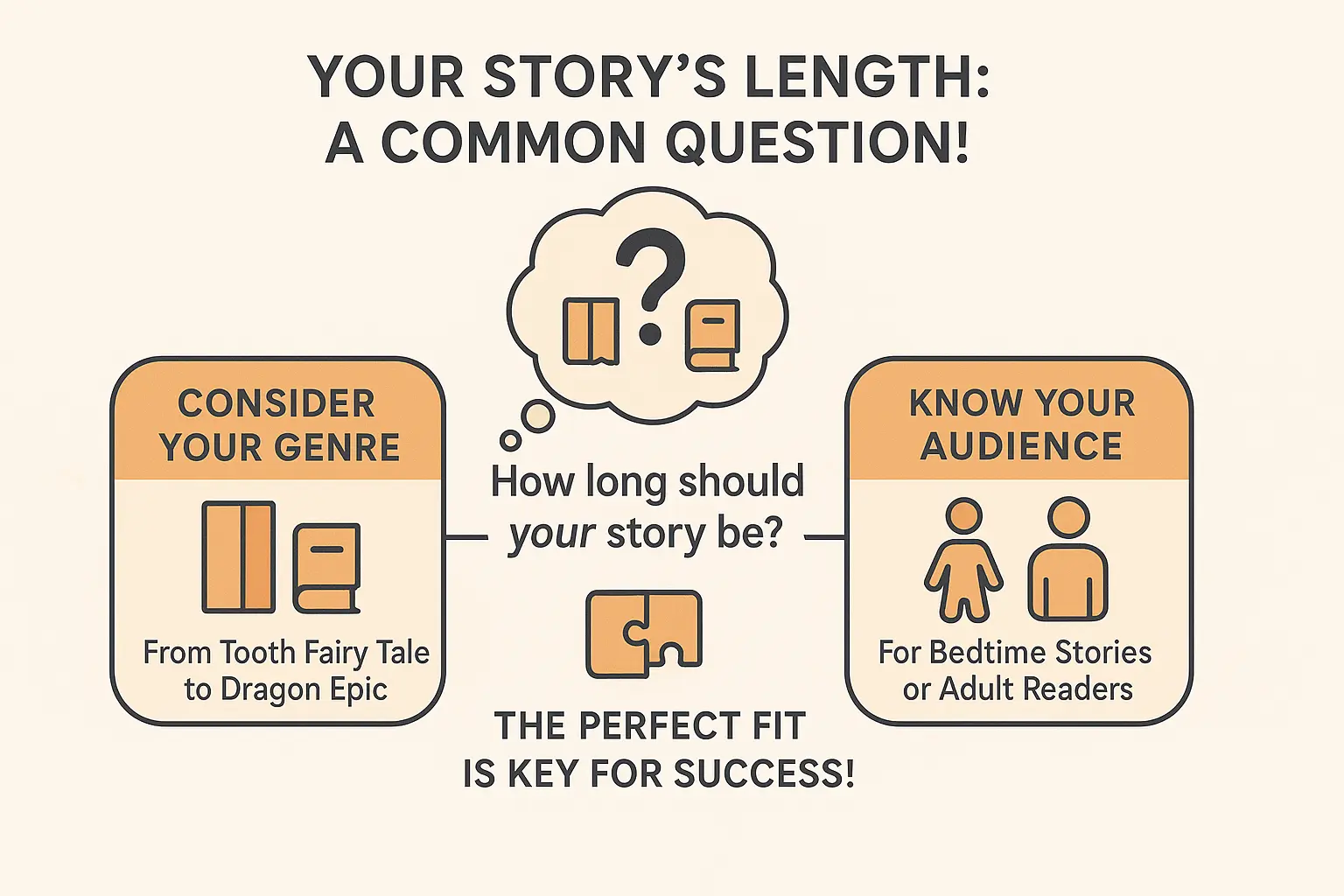
Think about it: a dragon epic needs more pages than a tooth-fairy tale. Get the length wrong and you’ll lose readers fast. Too short? They’ll breeze through it. Too long? They’ll drift off mid-chapter (or during a bedtime story… 😴).
 Story length guide infographic” width=”600″ height=”400″>
Let’s break down what shapes story length. Genre rules matter: thrillers stay tight at 70k-90k words, fantasy epics stretch to 120k+ for world-building. Kids’ books? Strict guidelines: 500-600 words for picture books, 20k-50k for middle-grade. Tellmestories parents know 3-year-olds won’t sit through a 10-page epic! 📚
Here’s the catch: audience expectations clash with practical limits. Teaching potty-training? Keep it snappy. Building a dragons-and-robot universe? You’ll need room to breathe. Printing costs rise with page count, while platforms like WhatsApp 💬 thrive on brevity.
Ready to match your idea to the perfect length? Let’s dive into the blueprint. Spoiler: it’s all about balancing depth with attention span. 🔍
Why story length is more than just a word count
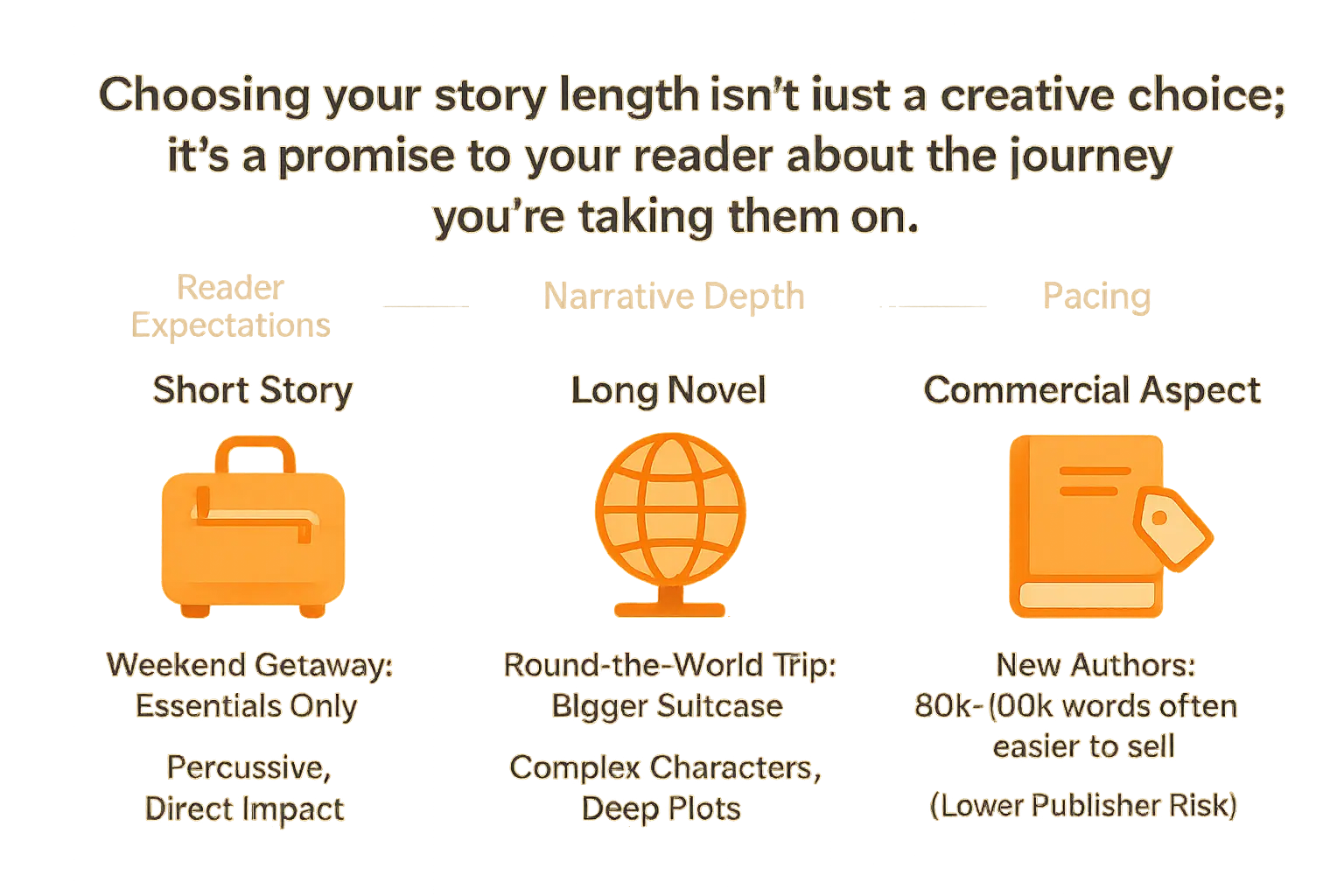
Ever wondered why some stories feel “just right” while others drag or leave you wanting more? Story length isn’t random – it’s your first promise to readers about the journey they’re signing up for. Let me break it down for you!
Think of it like packing for a trip. A short story is a weekend getaway – you only bring essentials. A novel is a round-the-world adventure needing a bigger suitcase! 🧳 This choice shapes everything: character depth, plot twists, and even reader patience.
For new writers, shorter novels (80k-100k words) often work better. Why? Publishers love them! They’re cheaper to print and less risky. But don’t think shorter means easier – every sentence must pack a punch. Got a complex fantasy world to build? You’ll need 90k+ words to make it shine. 💡
“Choosing your story length isn’t just a creative choice; it’s a promise to your reader about the journey you’re taking them on. Get it right, and they’ll follow you anywhere.”
Reader expectations matter! Kids’ books stay tight (500-600 words for picture books), while sci-fi epics stretch out. Miss these marks? You’ll frustrate readers – imagine a 30-page fairytale or a 120k-word romance saga! 📖
Pacing changes everything. Short stories need lightning-fast action. Novels have room for slow-burn character arcs. Remember: depth vs. speed is your balancing act. Add too many subplots in a novella? You’ll lose everyone. Keep it tight!
Here’s the kicker: split stories badly, and you’ll anger readers. Split them right, and you create buzz! Ever seen movie trilogies that split books? That’s the secret sauce – each part needs its own complete arc. 🎬
So next time you start writing, ask: “What suitcase does this story need?” Your answer shapes everything from character growth to chapter structure. Nail this, and you’re halfway to reader satisfaction! ✨
A quick guide to standard story lengths
Let me break this down with a handy reference chart. It’s like choosing the right backpack for your adventure – you want one that’s just right for your storytelling journey! 🚗
| Format | Typical Word Count | What it’s great for |
|---|---|---|
| Flash Fiction | Under 1,000 words | Capturing a single, powerful moment or idea |
| Short Story | 1,000 – 7,500 words | Exploring a single event or character arc in depth |
| Novelette | 7,500 – 20,000 words | Telling a story too complex for a short story but not quite a novel |
| Novella | 20,000 – 50,000 words | Focusing on one character’s emotional journey with a straightforward plot |
| Novel | 50,000 – 110,000 words | Building rich worlds with multiple characters, subplots, and deep themes |
| Epic/Saga | 110,000+ words | Creating vast, sprawling worlds and multi-generational stories (think Lord of the Rings!) |
Let’s unpack these formats. Flash fiction needs to hit hard and fast – it’s the literary equivalent of a perfect Instagram post, just shorter. Every word matters like painting a thunderstorm in three brushstrokes.
Short stories give you room to breathe while keeping things tight. They’re perfect for diving deep into one specific event or character transformation without subplots getting in the way. Think of your favorite movie scene stretched into novel form.
Novelettes are the “Goldilocks zone” for stories that have more complexity than a short story but aren’t ready to be full novels. Explore a secondary character’s perspective or add one extra twist without committing to novel territory.
Novellas are where single character journeys really shine. Explore emotional depths while keeping the plot focused – perfect for stories that outgrow short story limits. Imagine telling a complete life story without needing a family tree.
When we hit novel territory, suddenly we’ve got room for multiple characters, interwoven subplots, and world-building that rivals Tolkien’s Middle-earth. Create entire fantasy realms with unique currency and weather patterns. 📘
For epic sagas, go all-in with multi-generational family drama or political intrigue that’ll make readers forget their favorite TV show for days. Just remember – longer isn’t always better! 📚
Let your genre be your guide
Choosing the perfect length for your story isn’t just about hitting a random word count. It’s about matching your genre’s rhythm and your audience’s expectations. Let’s break it down—your genre is like a secret decoder ring for pacing, depth, and keeping readers hooked. Ready to dive in? 🚀
Thrillers and mysteries
Thrillers and mysteries thrive on fast-paced action and tension. Aim for 70,000–90,000 words. Why? Because readers want twists and turns without dragging. Too short, and the plot might feel rushed or leave plot holes. Too long, and the suspense dies. Think of it like a rollercoaster—keep the momentum steady, and leave them gasping at the end. Bonus tip: series fans might expect shorter books for quick binges, while standalone thrillers can stretch toward 90k to wrap up all threads.
Science fiction and fantasy
For sci-fi and fantasy, world-building is your playground. Target 90,000–120,000 words (or more if needed). These genres demand rich details—alien tech, magic systems, or dystopian societies. But don’t overdo it! Every extra word should add depth, not just filler. Imagine painting a universe where readers can get lost, but still find their way back to the plot. Need inspiration? Think of how Harry Potter starts smaller and grows with its characters—your world-building should evolve naturally, not overwhelm.
Romance
Romance is all about the relationship journey. Keep it between 50,000–100,000 words. Shorter stories (around 50k) work for lighthearted reads, while longer ones let you explore emotional arcs. The key? Make the love story feel earned. If the characters’ connection feels rushed, even 100k words won’t save it. Think of it as slow-burn vibes vs. instant sparks. 💘 Pro tip: subplots (like career challenges or family drama) can add layers without bloating the word count.
Historical fiction
Historical fiction needs to set the scene without drowning readers in facts. Aim for around 100,000 words. This gives you room to weave in historical details while keeping the narrative flowing. But remember: the past is just the backdrop. Let your characters’ struggles shine through the era’s quirks—like a time machine with emotional depth. Watch out for research overload! Sprinkle facts like seasoning, not stuffing. Your readers came for the story, not a textbook.
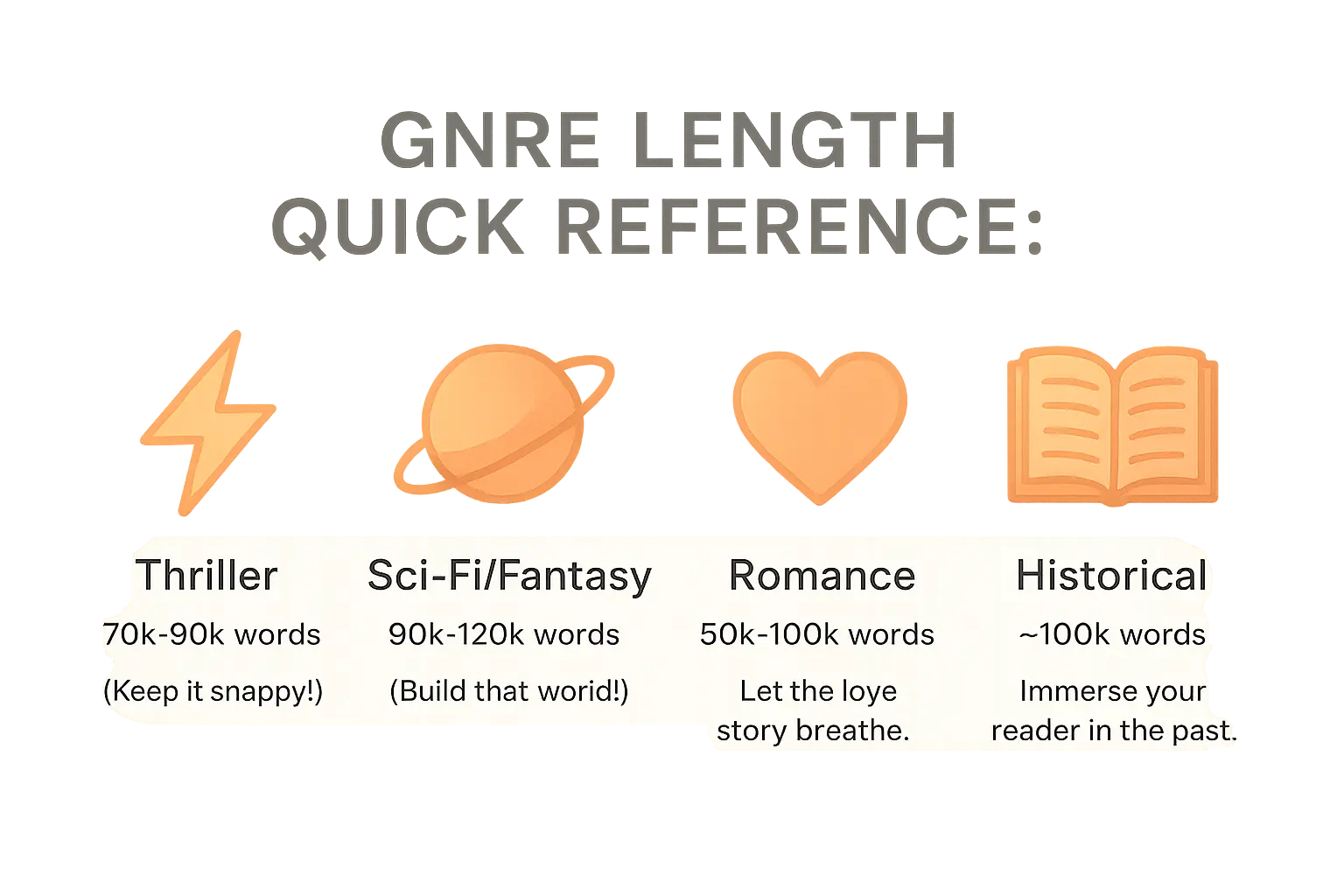
Genre Length Quick Reference:
- Thriller: 70k-90k words (Tension > filler!)
- Sci-Fi/Fantasy: 90k-120k words (Build that world—but keep the plot moving!)
- Romance: 50k-100k words (Slow-burn? 80k+. Quick crush? 60k does the trick.)
- Historical: ~100k words (Balance facts with character drama.)
Pro tip: Indie authors can bend these rules slightly—readers on platforms like Kindle Unlimited often love longer series—but traditional publishing? Stick to the guidelines. Publishers know what sells! 📚
The special case: writing for kids
Ever wondered how to keep your little one hooked on a story without losing their attention? 👶 For kids, story length must match their magical (but short!) attention span. Our WhatsApp-powered service makes this easy-peasy 📚 with AI that remembers your child’s favorite characters for continuity!
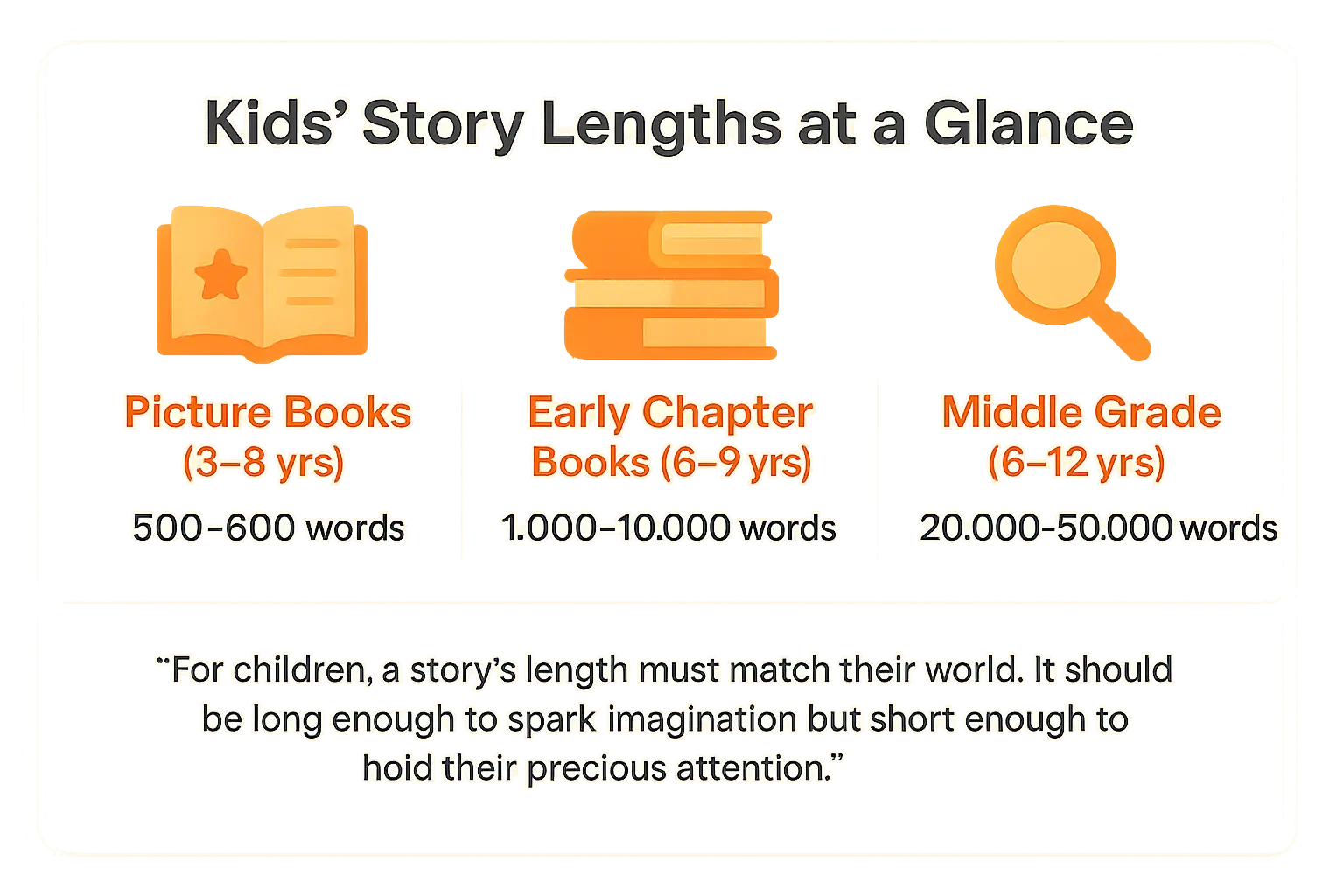
“For children, a story’s length must match their world. It should be long enough to spark imagination but short enough to hold their precious attention.”
Picture books (ages 3-8)
Keep it snappy! 📖 These stories work best at 500-600 words. Why? The illustrations carry half the magic, so the text needs to be punchy. Perfect for bedtime routines – imagine wrapping up a cozy adventure in just 5 minutes! 🌙 Our AI suggests characters from past tales to keep things familiar.
For toddlers and preschoolers, even a few hundred words can be perfect. That’s why short bedtime stories simplify bedtime routines effectively.
Early chapter books (ages 6-9)
Now we’re getting somewhere! 📚 This age group handles 1,000-10,000 words like pros. Short chapters create that sweet “I finished a whole book!” moment. Think of it as training wheels for reading – every 500-word chapter is a mini-victory! 🏆
Our voice-to-story feature lets busy parents create adventures by recording a WhatsApp voice note. Just speak your idea and boom! Your child becomes the story’s hero 🦕.
Middle grade (ages 8-12)
This is where the real adventure begins! 🚀 Kids this age dig 20,000-50,000 words – long enough to build entire worlds but not too complex. Perfect for teaching life lessons through stories (potty training, first day jitters – you name it!).
See themselves in stories through photos 📸 with our character personalization feature!
- Picture Books (3-8 yrs): 500-600 words
- Early Chapter Books (6-9 yrs): 1,000-10,000 words
- Middle Grade (8-12 yrs): 20,000-50,000 words
Format matters too! Explore story formats, from text to audio – create adventures by sending a WhatsApp voice note! 🎧
 Kids story lengths visual guide” />
One Big Book Or A Whole Series?
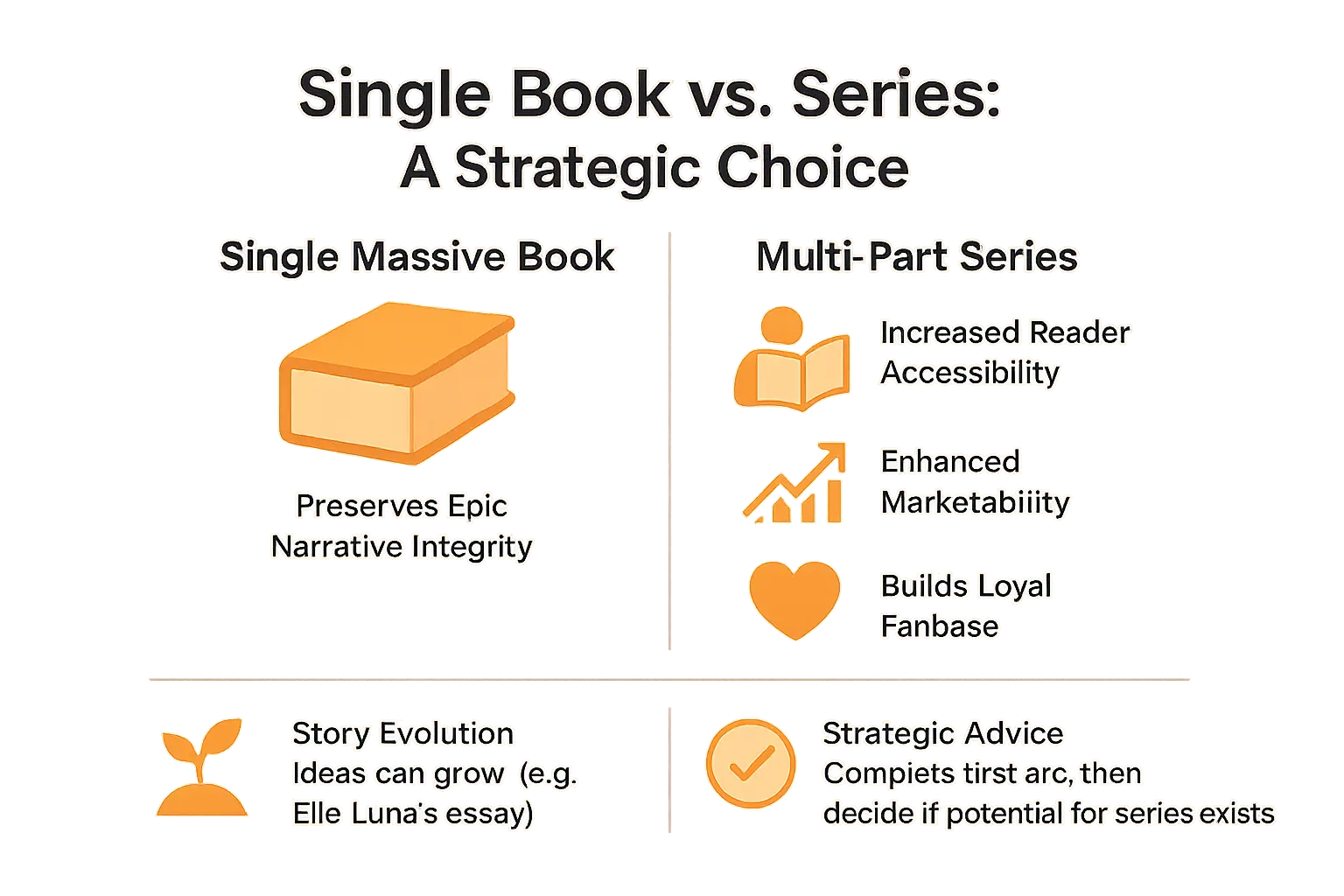
What if your story feels… massive? Like, really, really big? 🤯 You might be facing a classic writer’s dilemma: do you publish one epic tome or split it into a series? Let me break this down for you.
First, let’s acknowledge this hot take: new authors often get better traction with shorter books. Why? Publishers love lower printing costs, and readers expect familiar page counts. But here’s the twist – genres like fantasy (90-120k words) and thrillers (70-90k words) play by different rules. Even J.R.R. Tolkien went full epic with 175k words in LOTR, but let’s be real – that’s 1% of authors’ special privileges.
Pros Of Splitting Into A Series
- Reader investment grows with each volume
- Marketing snowballs – first book promotes all
- Cliffhangers keep fans hungry for more
- Perfect for complex world-building
Cons Of Going Solo
- One-shot stories might feel incomplete
- Less room for deep character arcs
- Harder to stand out in crowded markets
Here’s where it gets juicy: Quora writers reveal secret sauce – some authors choose massive tomes for pure narrative integrity. But modern magic happens when stories evolve, like Elle Luna’s famous essay morphing into a full book. Your “short story” could be a future novel’s skeleton!
Pro tip: Nail your first narrative arc’s ending. If the story feels complete but whispers “there’s more,” you’ve found series gold. Keep readers hooked by balancing depth and pacing – like Tellmestories’ WhatsApp tales that adapt to each child’s journey, proving great stories know no fixed length.
Trust Your Story: Finding The Perfect Fit For You
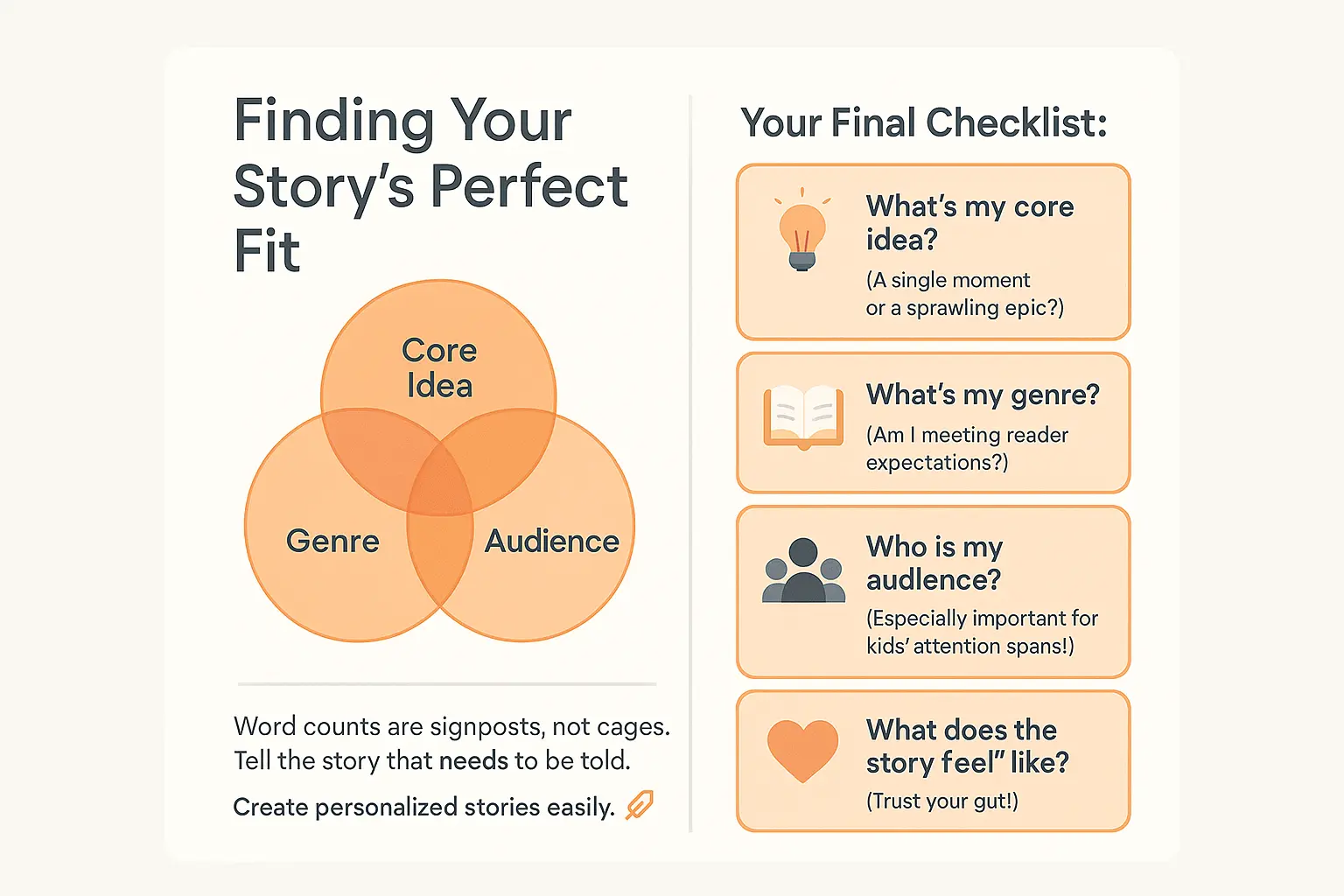
You know what? Choosing the right story length isn’t about rigid rules—it’s about harmony. Your core idea, genre expectations, and audience needs must align like puzzle pieces. Think of it this way: a space opera needs room to explore galaxies, while a bedtime story for a 4-year-old should wrap up before their attention drifts. Makes sense, right?
Here’s the deal: those word counts you see online? They’re guidelines, not handcuffs. Some stories break the mold and thrive. But for most of us, sticking close to expectations helps readers connect faster. Especially with kids—no parent wants to see their little one squirming mid-story!
Want a shortcut? Try Tellmestories. Just shoot a voice note on WhatsApp describing your child’s favorite things—no typing needed. Our AI crafts personalized tales that match their age, interests, and attention span. Want proof? Over 10,000 families have already turned bedtime battles into cozy bonding moments this way.
Still unsure about length? Here’s your final checklist:
- What’s my core idea? (A single moment or a sprawling epic?)
- What’s my genre? (Does it meet reader expectations?)
- Who is my audience? (Kids’ attention spans matter!)
- What does the story feel like? (Trust your gut!)
Remember: your story finds its true length when you stop chasing formulas and start listening. Listen to your characters, your audience, and that little voice whispering “this part feels right.” Ready to test-drive this in real life? Tap below to create your first personalized story—it takes just 90 seconds, and we’ll handle the word count math for you 📱✨
Start your story adventure now—no app downloads, no complicated forms. Just pure storytelling magic in WhatsApp.
The secret to choosing your story length? Balance core idea, genre, and audience needs. Numbers are guidelines, not rules. Ready to write? Craft tales or epics. For kids’ stories, Tellmestories.ai crafts personalized magical adventures in minutes. Let creativity lead—and watch their eyes light up! ✨📚
FAQ
Can I pick how long my Instagram story lasts? ✅
You bet! Instagram stories are super flexible. Here’s the deal: if you’re posting a photo or video from your camera roll, you can choose between 15 or 60 seconds per slide. The cool part? When using the camera directly in the app, your story can be as long as you want by swiping through slides. Just remember – stories disappear after 24 hours unless you pin them to your profile! 🎥
How do I make my story clips longer or shorter? 🎛️
Great question! When editing your story, tap the timer icon ⏱️ to switch between 15s and 60s durations. Want to get fancy? Use the “Create Mode” by holding the capture button – this lets you make clips anywhere from 1-60 seconds long. Pro tip: Shorter clips work better for fast-paced content, while longer ones let you dive deeper into your story. 🕒
Is there a way to change my story’s length after posting? ❌
Unfortunately nope – once it’s up, the duration is locked in! But don’t worry, you can always delete the story and re-post it with your preferred timing. Here’s a hack: Before sharing, hold the capture button to preview your story length – that way you get it right the first time! 🚫
Why is my story only 15 seconds long? 🤔
Oh I feel you! This usually happens when you’re using video content from your camera roll. Instagram limits single video stories to 15 seconds by default. The fix? Split your video into multiple 15-second chunks or use the story editor to adjust timing before posting. You can also try Instagram’s “Create Mode” for more control over clip lengths. 🎬
How do I switch from 15s to 60s stories? 🔄
Quick and easy! While creating your story, look for the timer icon (it looks like a clock) at the bottom of your screen. Tap it once and BAM – you’re now in 60-second mode! This works great for tutorials or when you want to share more with your audience. Just remember to keep your content engaging since folks might swipe away if it’s too long. 👀
Can I make my story shorter than 15 seconds? ⏱️
Not exactly – Instagram sets a 15-second minimum for standard stories. But here’s a cool workaround: When creating multiple slides, you can make individual slides longer or shorter by using the “Create Mode” (hold the capture button). This way, your total story can be super short while still respecting the platform’s rules. 🎯
What if my story is too short? 📉
Feeling like your story needs more? If it’s looking a bit, well, brief – here’s what to do: Try using the 60-second option for longer videos, or add multiple slides to stretch your message across several 15s-60s segments. You can also get creative with text overlays and interactive stickers to make the most of every second! 📎
How do I control how long my story stays up? ⏳
Here’s the fun part – you totally control that! By default, stories live for 24 hours, but you can delete them anytime by tapping the trash can icon. Want to keep it longer? Tap “Highlight” to save it to your profile. These stay forever until YOU decide to remove them. How cool is that? 🌟