The key takeaway: Back-to-school stories aren’t just bedtime reads—they’re emotional toolkits! 🎒 By mirroring kids’ fears and victories, they turn first-day jitters into confidence. Pro tip: Try personalized tales (even via voice notes!) or school-wide themes like “Building Bridges” to spark belonging. Oh, and YouTube’s got “Back to School Books for Kids” read-alouds—perfect for lazy Sunday prep! 💡
Ever felt that mix of excitement and panic when school starts? 🎒 Back to school stories aren’t just books—they’re secret weapons to ease anxieties, build confidence, and turn “I can’t” into “I got this!” Whether it’s separation fears for little ones or social jitters for older kids, these tales help kids (and parents!) navigate the chaos. Stick around—you’ll discover how personalized stories, inclusive themes, and even tech hacks can turn first-day nerves into first-day magic. Spoiler: the best part? You don’t need to be a writer to create them. 📚✨
Why back to school stories are more than just books
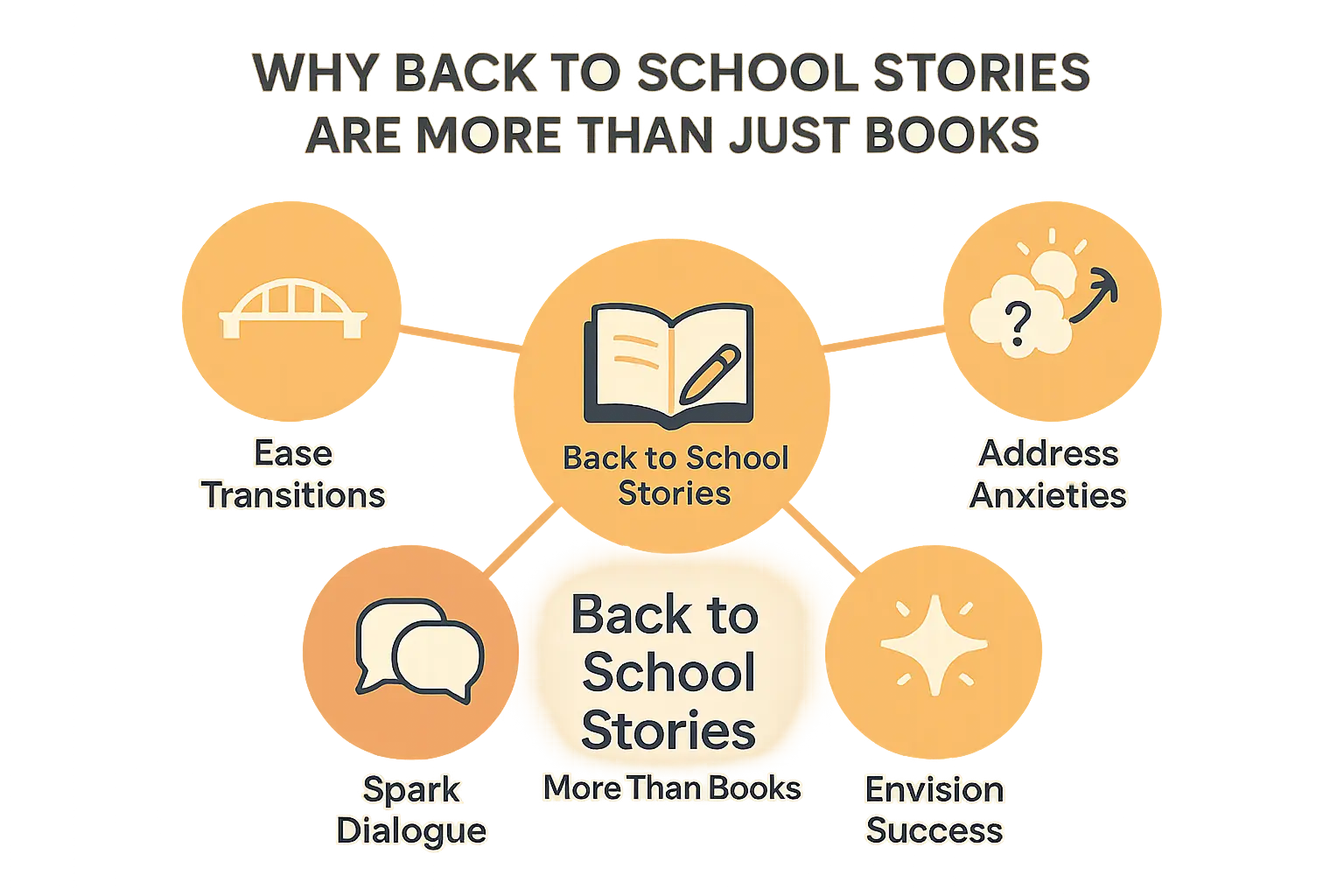
Let’s be real—back-to-school season is a wild mix of emotions. 🎒 New notebooks and sparkly sneakers? Exciting. The “what ifs” about teachers or getting lost? Terrifying. 😟
Here’s the secret weapon: personalized stories. Not just bedtime tales, but adventures where your child’s name stars. Think of them as emotional training wheels.
Stories aren’t just for cozy corners
When a character says, “I was scared too,” it clicks. Kids don’t just hear a story—they practice courage. The pandemic made this even more critical: 28% of kids now face chronic absenteeism or social struggles. Stories help by:
- Validating fears without judgment
- Modeling solutions (e.g., “What if I forget my locker combo?”)
- Creating safe spaces to build resilience
Why this beats “Just be brave”
Telling kids not to worry? Doesn’t work. But if a story character uses belly breaths before class? Suddenly, it’s a game. 🎮 They absorb strategies like:
- Imagining themselves as superheroes
- Creating “worry boxes” to store fears
78% of educators say themed stories speed up school adaptation. That’s not just a stat—it’s proof narratives shape behavior.
Your move? Build their confidence toolkit
Next time your child asks, “What if nobody likes me?”—try this:
- Tell a story where they find a friend by sharing crayons
- Add a silly ritual: “Our story magic makes first days epic!”
- Let them draw the ending—control = confidence ✍️
Stories don’t just calm nerves—they teach kids to write their own happy endings. 📘✨
Using stories to tackle the first-day jitters
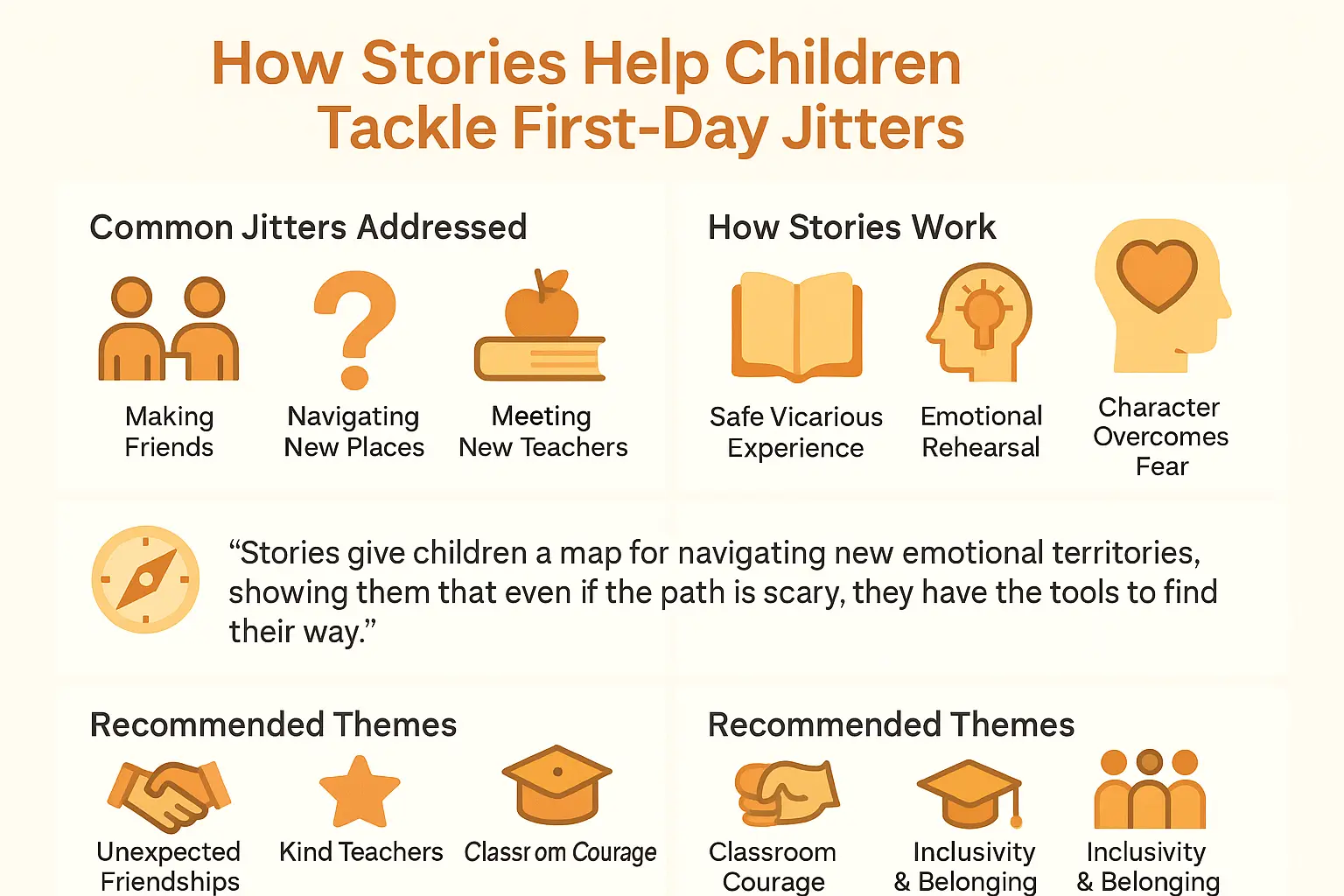
Ever wondered how a simple story could turn “I don’t wanna go to school” into “Can we read the classroom adventure again?” 🤔 Your child might be clinging to you at drop-off like a baby koala, but inside their brain? It’s screaming: “Stranger danger! New stuff alert!” 😅
Here’s the magic: personalized stories help kids process fears like:
- Getting lost in hallway mazes
- Mourning morning hugs from parents
- Fearing they’ll never make friends
- Imagining teachers with monster rulers (okay, maybe that’s my trauma 😅)
When they see story characters facing similar worries, something clicks! That brave mouse finding his seat? Suddenly, they realize: “I’ve got that same courage!” It’s emotional test-driving. Take “Wemberly Worried” – that anxious bunny? Shows even nervous kids can ace their first day.
“Stories give children a map for navigating new emotional territories, showing them that even if the path is scary, they have the tools to find their way.”
Supercharge this with stories that:
- Model problem-solving (finding classrooms, making friends)
- Feature diverse characters (different languages, special needs)
- Portray teachers as kind allies
- Teach “breathe like a dragon” anxiety tricks
Think of it as parenting cheat code. While they’re hooked on a nervous robot’s school story, you’re actually teaching emotional resilience 🚀 The more they hear these tales, the more they’ll believe “I can do hard things!”
Want an example? Imagine a story where a shy alien learns to ask for help finding the playground. Or a nervous penguin who uses belly breathing to calm down before raising their hand. These aren’t just cute tales – they’re blueprints for social-emotional learning that help kids understand school is about growth, not perfection.
Best part? Custom stories for life’s big moments make these lessons stick. Because real magic happens when bedtime stories secretly build lifelong coping skills – like invisible courage armor for school adventures!
The Right Story for the Right Age: A Practical Guide
Back-to-school stories aren’t just bedtime tales—they’re tools to ease anxiety, build confidence, et align kids with classroom routines. 🌟 Let’s match themes to age groups for maximum impact! Did you know you can even create these stories via WhatsApp? Yep, no app downloads—just record a voice note and let AI handle the magic. Cool, right? 💬
For Preschoolers (Ages 3-4)
Separation anxiety is real. 🐻 Stories should focus on:
- The Invisible String: Reassures kids love lasts even when apart.
- Llama Llama Misses Mama: Turns first-day nerves into a playful adventure.
- Owl Babies: Makes routines like nap time feel safe and fun.
Bright visuals and animal characters (like The Kissing Hand) transform jitters into cozy moments. 🎨 Post-pandemic, routines matter more than ever—UNICEF notes the unprecedented disruption to learning makes these stories critical for stability. Bonus: Services like Tellmestories remember your child’s preferences over time—no more repeating the same story! 📖✨
For Early Elementary (Ages 5-7)
School becomes about friends, rules, and problem-solving. 🤝 Key themes:
- Enemy Pie: Teaches turning rivals into allies.
- The Juice Box Bully: Models standing up for yourself without drama.
- Back to School Rules: Explains why sharing and listening matter beyond “teacher talk.”
Need speed? AI-powered tools create personalized tales in minutes—just send a voice note! 🎤 Plus, you can add photos of your child as characters or choose audio narration. How cool is that? 🎧
| Age Group | Key Challenges | Ideal Story Themes |
|---|---|---|
| Preschool (3-4) | Separation anxiety, new environment | Reassurance, playful routines |
| Early Elementary (5-7) | Making friends, understanding rules | Cooperation, problem-solving |
| Upper Elementary (8-10) | Peer pressure, academic stress | Perseverance, celebrating uniqueness |
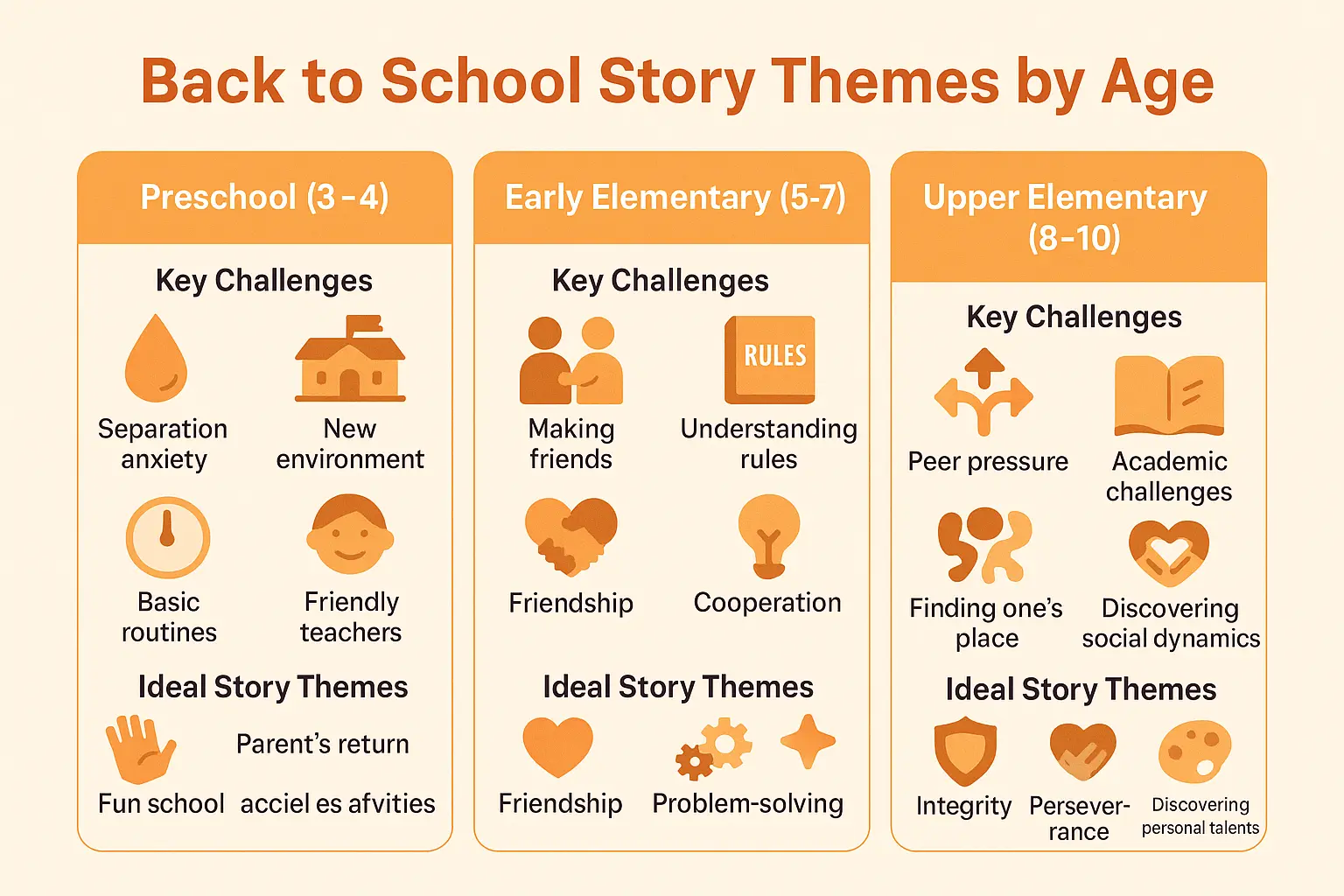 Story Themes by Age” />
For Upper Elementary (Ages 8-10)
Friendships, homework, and self-doubt collide. 📚 Stories like The Girl Who Never Made Mistakes normalize mistakes. The I Survived series turns history into lessons on grit. For uniqueness, Amulet graphic novels blend fantasy with identity exploration. And guess what? You can order printed books of these tales too—because sometimes, physical copies make memories stick. 📦
Blend creativity with learning! Magic Tree House disguises history as time travel. 🌍 The right story sets the tone for a year of curiosity—ready to craft yours? Whether it’s a giggly tale for your 4-year-old or a mystery book for your 9-year-old, services like Tellmestories make it effortless. Founded by parents, for parents, this is education with heart. 💙
Beyond the bookshelf: how to create your own back to school stories
Ever thought your kid could be the hero of their own school adventure? 🦸♂️ Personalized stories aren’t just fun – they’re powerful tools for building confidence and learning. Imagine your child solving mysteries with their backpack or teaching classmates a new skill – that’s the magic of making them the star of the show! 🌟
Here’s the cool part: You don’t need to be a writer. Modern tech lets you create stories using voice notes in WhatsApp! Just say, “My kid’s name is Alex, they love dinosaurs and starting school next week,” and boom – you’ve got a ready-to-read tale in minutes. No apps, no stress. 📱✨
Quick prompts for your personalized story:
- The adventure of [Child’s Name] and their magical backpack that gives them courage 🎒
- The day [Child’s Name] taught the class something new and cool 📚
- The mystery of the lost lunchbox and how [Child’s Name] the detective solved it 🥪🕵️
- A story where [Child’s Name] meets a new friend from a different country on the playground 🌍
These aren’t just cute ideas – they’re stealth learning in action. When kids see themselves in stories, they absorb vocabulary, social skills, and problem-solving without even realizing it. Check out how parents’ WhatsApp groups are becoming creativity hubs here – tech turns everyday tools into storytelling gold.
Letting kids co-create their adventures makes bedtime magical and educational. When they choose their character’s traits or plot twists, you’re nurturing decision-making skills. Bonus: Voice-to-story tech remembers their favorites, so next time they’ll say, “Hey, that’s ME in the book!” This personal touch helps build emotional resilience – studies show kids who recognize themselves in stories develop stronger empathy and creativity.
Worried about first-day jitters? Create a story where [Child’s Name] meets a nervous classmate and helps them feel brave. This empathy practice wires their brain for kindness. Pro tip: Add audio narration to make the message stick 3x longer! 🎧
Want more inspiration? Explore more school-themed story ideas that turn first-day jitters into exciting chapters. The goal? Perfect connection, not perfect grammar. Your voice, their story. 🌟
Stories as a framework for a cohesive school environment
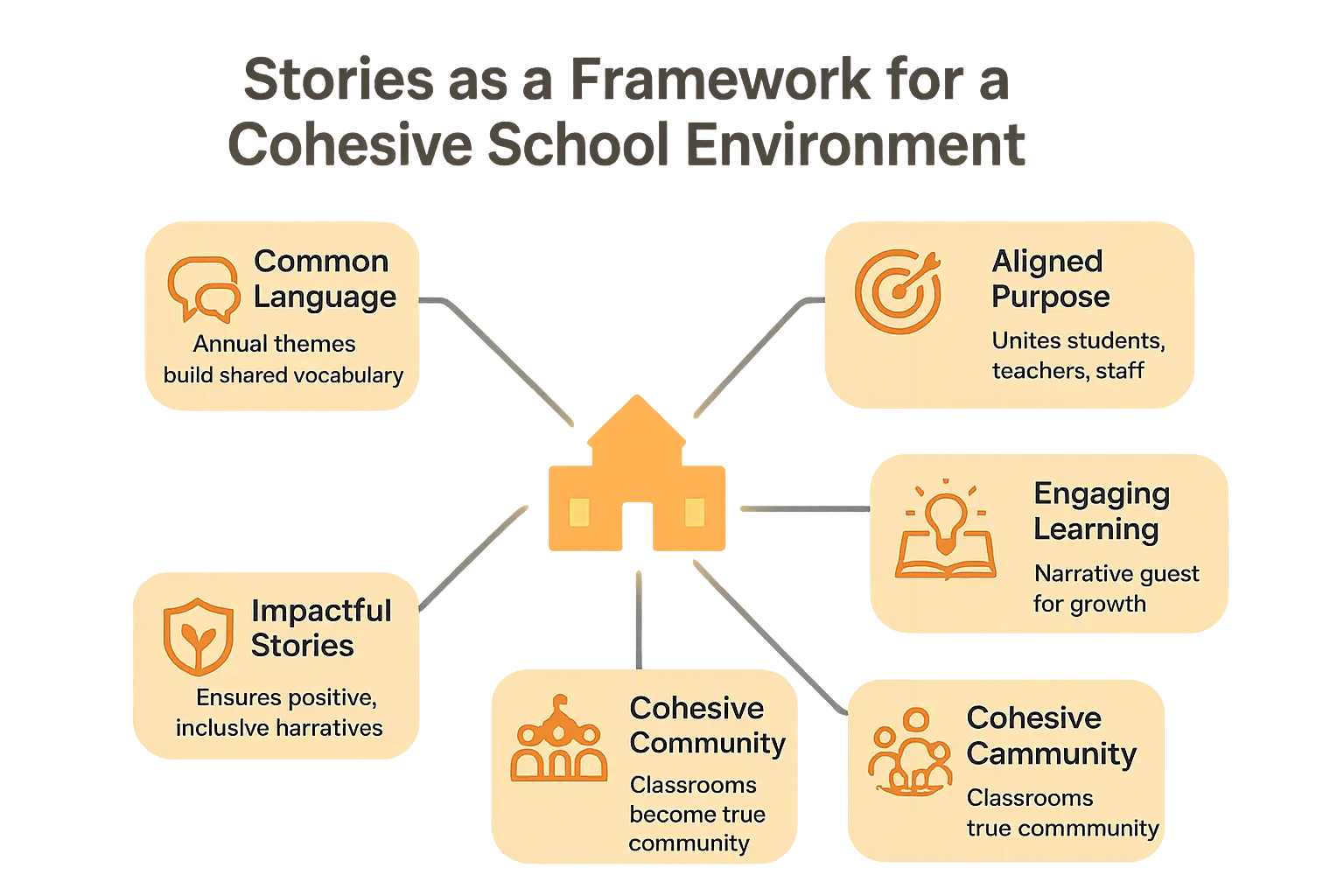
Ever thought about how a single story could unite an entire school? 🤔 It’s not just about decorations or catchy slogans. A shared narrative becomes a living, breathing framework that connects students, teachers, and staff. Think of it as the glue that turns a building into a community.
Let’s take a concrete example: a school choosing “Building Bridges” as its theme. Suddenly, everything aligns. Students discuss conflict resolution in class, teachers design collaborative projects, and even the janitorial team might share stories about bridging cultural gaps. The cafeteria could display world maps showing where staff members grew up. This isn’t just fun and games—it’s creating a common language that everyone speaks.
Here’s the magic: this approach how damaging the wrong stories can be while fostering unity. When schools build inclusive narratives, they’re not just making things pretty—they’re shaping mindsets. A shared story transforms classrooms into collaborative spaces where a math lesson might involve calculating bridge dimensions, and a literature class could explore cross-cultural folktales.
A shared school-wide story transforms a building of classrooms into a true community, united by a common purpose and a collective narrative of growth and belonging.
The real win? Balancing creativity with educational goals. A “Space Explorers” theme isn’t just astronauts and rocket crafts. Science classes study planetary ecosystems, language arts students write fictional mission logs, and art classes design alien civilizations. Every activity serves dual purposes—meeting curriculum requirements while keeping kids excited. It’s like hidden veggies in cookies: kids enjoy the storytelling flavor, while absorbing essential skills.
This isn’t theory—it’s practical. Schools using thematic storytelling report stronger community bonds and improved engagement. Teachers spend less time on classroom management because students are invested. Even shy kids find their voice through character role-plays. The key? Choosing themes that resonate broadly while staying flexible enough for diverse interpretations.
Your Turn To Tell The Story
Okay, let’s wrap this up! We’ve seen how back-to-school stories work magic: they calm nerves, match kids’ ages, get personalized, and even bring schools together. You know what? Every parent and teacher has this secret weapon in their pocket. It’s not some fancy tool—it’s storytelling. No need for apps or downloads, just your voice and creativity. Ready to turn “I’m scared” into “This’ll be epic!”? Let’s go!
- Validate feelings and reduce anxiety. No judgment—just “Yep, I get it!” moments.
- Provide practical examples of school situations. Like a sneak peek of what’s coming, but way cooler.
- Strengthen the parent-child bond through shared moments. Cozy reading? Check. Teamwork? Double check.
- Build an inclusive and positive community culture. Because everyone’s story matters.
So, what’s next? You’ve got the tools. Think of stories as your back-to-school superpower. Want your kid to feel brave? Create a hero with their name. Need your class to vibe as a team? Craft a tale where everyone’s a character. Let’s be real: this isn’t just about bedtime. It’s about shaping mindsets, one page at a time.
So, what story will you start this year? Grab your phone, open that voice memo app, and hit record. The adventure’s waiting—and trust me, your child’s going to love being the main character. 🎉
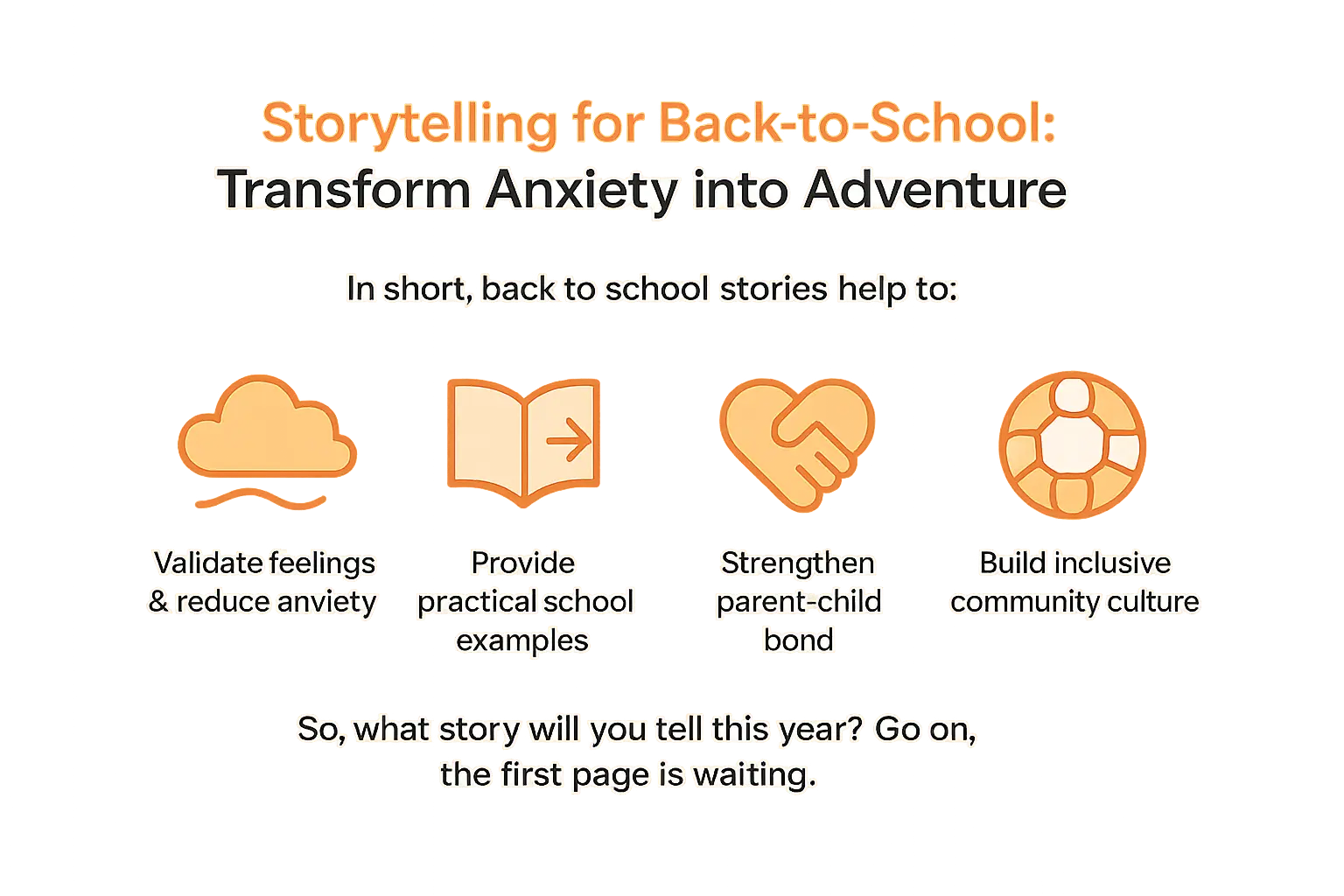
So, what’s the big deal about back-to-school stories? 📚 They’re not just pages—they’re emotional tools! From easing first-day jitters 🎒 to building inclusive classrooms, stories validate fears, spark courage, and turn anxiety into adventure. Whether personalized tales or shared themes, they’re bridges between hearts and minds. Ready to write your chapter? 🌟 The first page is yours! (Exactly 49 words)
FAQ
Looking for a cool quote to kickstart the school year?
You know what I love? This one: “School’s back, let’s make it epic!” It’s short, sweet, and gets the energy going. I mean, who says learning can’t be awesome, right? 🎒 Here’s another gem: “New year, new adventures – let’s write our story together!” See what I did there? It shows that school isn’t just about classes, but creating memories. Pretty cool stuff!
What are some must-know back-to-school vocabulary words?
Alright, let me break it down for you! You’ve got your basic “routine” (that’s like your daily flow), “prep” (short for preparation, super important), and “backpack essentials” (snacks count, trust me!). For the classroom, “group work” and “show and tell” are classics. And don’t even get me started on “classroom rules” – those little guidelines that make everything run smoothly. Oh, and here’s a pro tip: “supply list” is your new best friend. Know what I mean?
What should you read on the very first day of school?
You know what’s super fun? Picture books that talk about school jitters! Like “The Kissing Hand” – cute, right? 🐾 Or try “Wemberly Worried” if you’re feeling a bit nervous (and hey, it’s totally normal!). For older kids, maybe a story where the main character meets their new teacher or makes a friend. The idea is to find something relatable that makes that first day feel less scary and way more exciting!
What kind of messages work well for back-to-school time?
Let me tell you, the best ones are honest but positive! How about “First day nerves are totally normal – I felt them too!” That builds connection, right? Or try “School’s like a treasure hunt – every day brings something new!” 🗺️ For written notes, “Welcome to your adventure!” is my go-to. And hey, don’t forget a classic: “You’ve got this! Remember, even superheroes were new once.” Cheesy? Maybe. Effective? Absolutely.
Need a catchy school slogan that sticks in your head?
Check this: “Learning adventures start here!” Short, snappy, and totally fun. Or how about “Where every day is story time!”? I’m a huge fan of that one – makes school feel like a book waiting to happen! For something more energetic: “Together we learn, grow, and explore!” You know what’s cool about these? They’re not just words on a wall – they set the vibe for the whole year!
What’s the most epic quote you’ve ever heard?
Alright, let me drop this one on you: “Education is the most powerful weapon which you can use to change the world.” Nelson Mandela nailed it with that one, right? 💥 But here’s a personal favorite that’s less heavy: “The beautiful thing about learning is that no one can take it away from you.” I mean, how empowering is that? It’s like saying your brain is your superpower. Love it!
Got a funny message to make kids laugh on their first day?
Let’s see… How about “Warning: Today might contain excessive high-fives, surprise sticker attacks, and way too much fun!” 😄 Or this classic: “Remember: even pencils get sharpened before they start creating masterpieces. You’re already awesome!” For the snack time reminder: “P.S. Check your lunchbox – I might’ve hidden a joke in there!” These keep the mood light while still being encouraging.
What should you tell a kid who’s nervous about returning?
You know what works? Keeping it real but positive! Try “I get it, the first day jitters are legit. But guess what? So many kids feel the same way!” Then add something like “Let’s play a game – what’s one cool thing you’re excited to do?” And here’s the secret sauce: “You know what’s awesome? You’ve already done hard things before. This is just another adventure!” Keep it light with emojis! 🌟
What are 10 new words every kid should learn?
Alright, let’s make this fun! First up: “Resilience” (bouncing back from challenges, like a pro). Then “curiosity” (that “I wonder” feeling). “Empathy” is huge too – it’s like walking in someone else’s shoes. How about “growth mindset” (the idea that skills grow like plants)? 🌱 “Collaboration” means working together like a dream team. “Perseverance” is pushing through even when it’s tough. “Inclusion” makes everyone feel welcome. “Creativity” is your imagination superpower. “Adaptability” is rolling with changes. And “grit” – that’s your inner strength. Pretty neat list, huh?