The essential takeaway: School stories, rooted in 19th-century boarding schools, thrive on friendship, rivalry, and moral growth with secret societies and midnight feasts, from Charles Hamilton’s Billy Bunter to Enid Blyton’s Malory Towers. Post-WWII decline gave way to Harry Potter’s 1997-2007 revival, highlighting timeless lessons on courage, loyalty, and social dynamics in a world where every hallway holds a lesson.
Ever wondered why school stories still hook readers centuries later? 🤔 Beyond dusty classrooms and midnight snacks, these tales mirror life’s messy truths: friendship forged in chaos, underdogs defying bullies, and secrets that crack open worlds. From Tom Brown’s School Days to Harry Potter’s magical twist, we’re diving into the formula that made boarding schools feel like home – and why even today’s teens vibe with their drama. 📖✨ Think Malory Towers twists meets TikTok-era struggles: rivalry, courage, and the real magic of growing up. 🚀 Ready to unpack why these stories never get old? Let’s roll.
What exactly are school stories? 📚
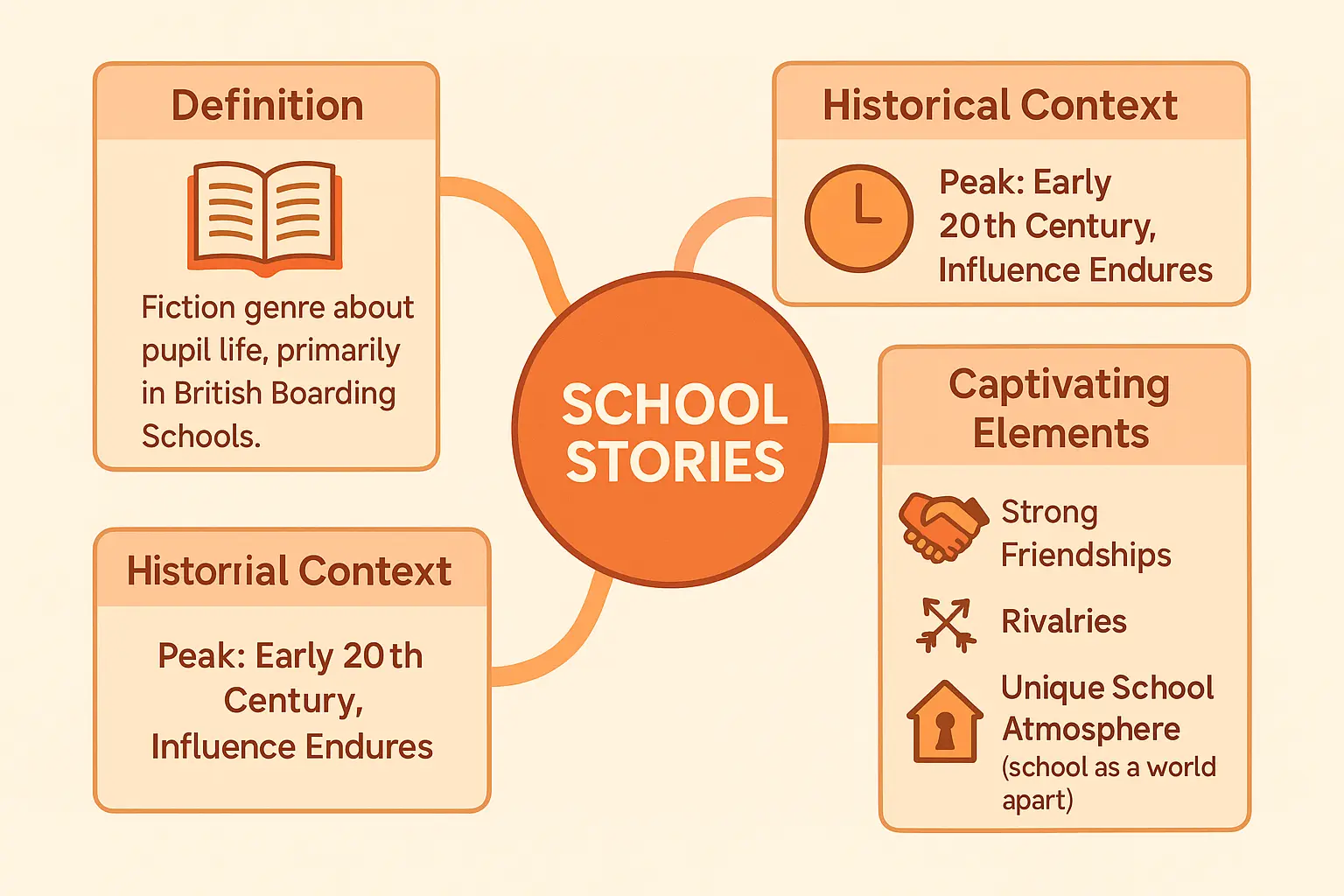
Ever wondered why boarding school tales captivated generations? School stories, a unique genre, explore pre-adolescent and teenage experiences in British boarding schools. These narratives thrive on themes like friendship, rivalry, and secrets, creating self-contained worlds where students navigate challenges under strict yet fair authority.
Peaking in the early 20th century, this genre’s roots have ancient origins. Let’s explore its evolution and iconic works.
The birth of a genre
The earliest example? Sarah Fielding’s 1749 novel The Governess, establishing autonomous school settings and moral lessons. While initially used as cautionary tales, the 19th century transformed them into mainstream entertainment.
Thomas Hughes’ 1857 novel Tom Brown’s School Days became the genre’s defining work, reshaping storytelling forever.
The book that changed everything
Tom Brown’s School Days set the blueprint for countless tales to come, focusing on moral growth, camaraderie, and school life trials in a groundbreaking way.
This novel depicted Rugby School’s transformative setting, modeling Victorian ideals through Tom Brown and Dr. Arnold. The 1870 Education Act expanded literacy, creating massive audiences.
By the 1880s, publications like the Boy’s Own Paper fueled demand. Talbot Baines Reed’s The Fifth Form at St. Dominic’s (1887) sold 750,000 copies by 1907, showcasing its enduring popularity before WWII shifted cultural interests.
The secret recipe for a classic school story
Ever wondered why school stories remain timeless? These tales follow a winning formula that’s enchanted readers for generations. Let’s break down the essential ingredients that make these narratives so irresistible.
At their core, school stories thrive on universal themes that resonate across ages. Friendship and loyalty stand out as pillars of these narratives. From midnight snack adventures to standing up against bullies, friendships in school tales often mirror real-life connections. Strong themes of friendship create emotional anchors that keep readers invested.
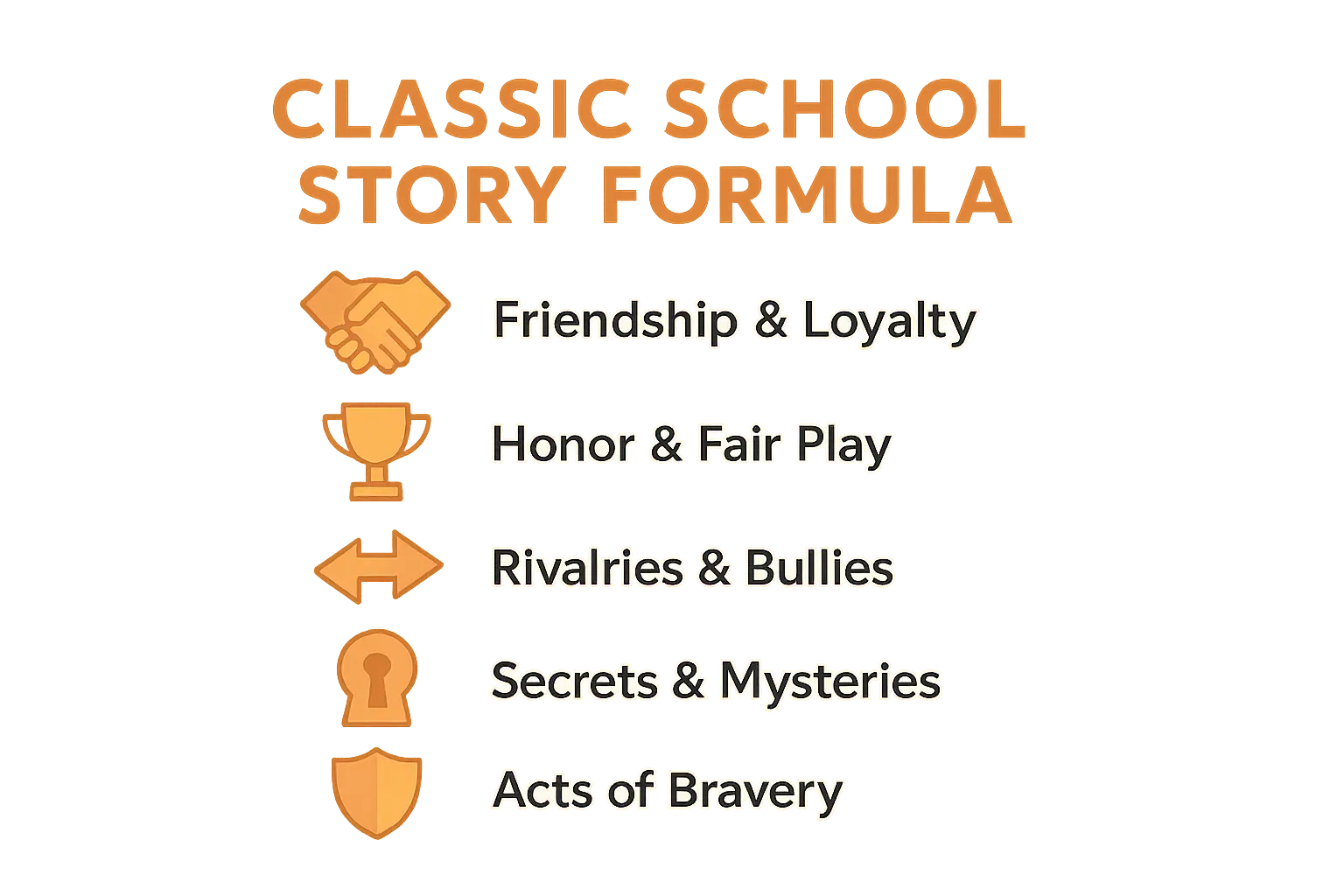
- Friendship and loyalty: Unbreakable bonds tested by challenges and rivalries
- Honor and fair play: Moral codes shining during sports competitions
- Rivalries and bullies: Conflict-driven growth through adversity
- Secrets and mysteries: Hidden passages and midnight escapades
- Acts of bravery: Courageous moments that define character
Sportsmanship emerges as another critical element. Cricket matches or hockey games aren’t just competitions – they’re moral battlegrounds where character shines brightest. These moments teach valuable lessons about teamwork and integrity without feeling preachy.
But no school story would be complete without its fair share of drama! Bullies and rival houses create tension that drives plot development. These antagonists actually serve a purpose – they test our heroes and reveal their true mettle when facing challenges.
The usual suspects: key characters
Every school story needs its cast of memorable characters. The wise headmaster acts as moral compass, balancing rules with understanding. Think of Mr. Chips or Dumbledore – figures who see beyond strict discipline.
Then there’s the school bully, often the catalyst for conflict. Whether it’s Malfoy in Harry Potter or Flashman in Victorian tales, these characters create tension that drives character growth. Their presence makes victories sweeter and friendships stronger.
The new kid brings fresh perspective. From Anne Shirley to Harry himself, these characters navigate unfamiliar environments, mirroring readers’ own experiences with change and adaptation.
Finally, identical twins inject humor through misunderstandings and clever schemes. They remind us that school isn’t all seriousness – mischief makes for memorable moments too!
A Tale Of Two Schools: Stories For Boys Vs. Girls
 boys and girls school stories“>
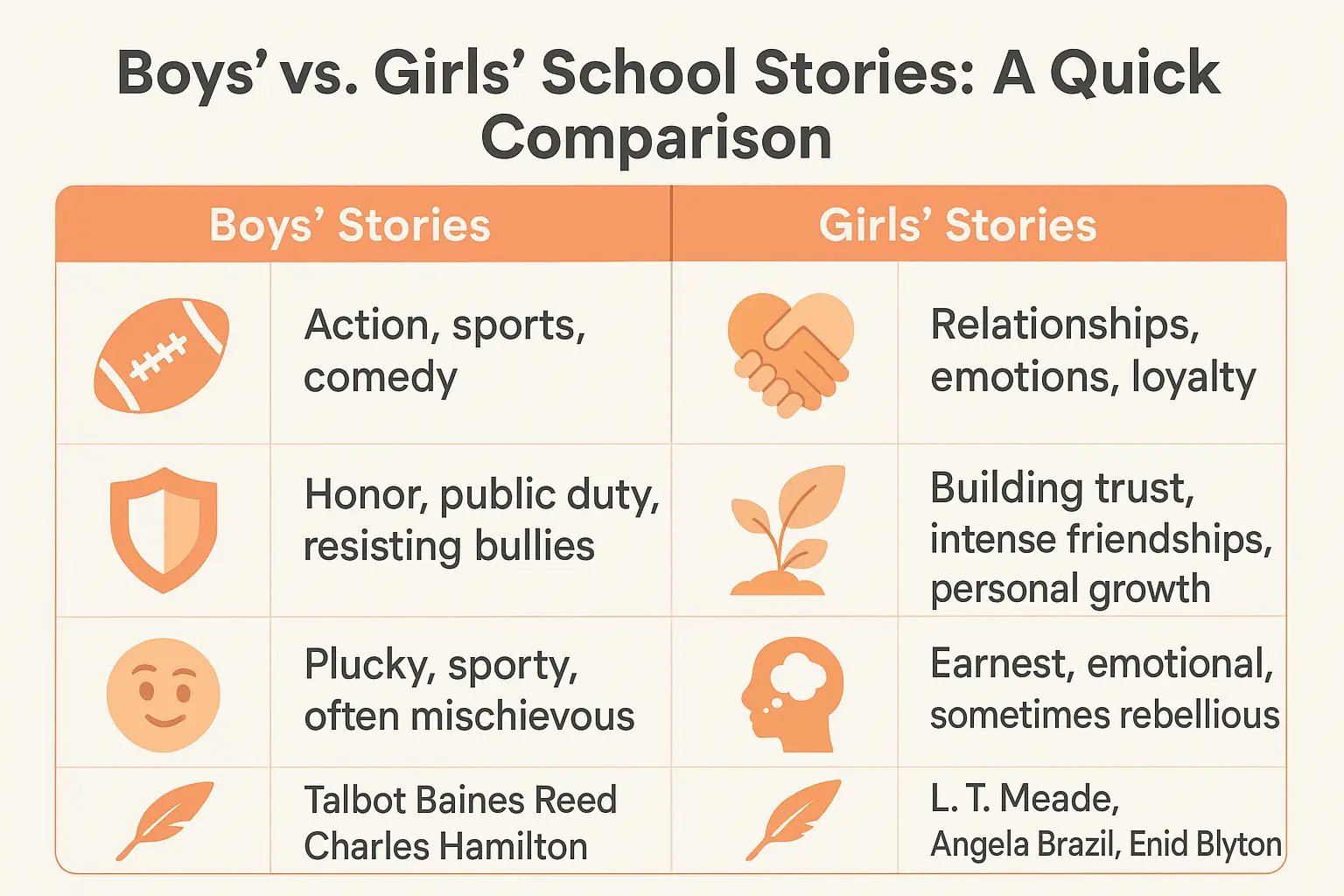
| Feature | Boys’ Stories | Girls’ Stories |
|---|---|---|
| Main Focus | Action, sports, comedy | Relationships, emotions, loyalty |
| Core Themes | Honor, public duty, resisting bullies | Building trust, intense friendships, personal growth |
| Protagonist Type | Plucky, sporty, often mischievous | Earnest, emotional, sometimes rebellious |
| Key Authors | Talbot Baines Reed, Charles Hamilton | L. T. Meade, Angela Brazil, Enid Blyton |
Before the 1950s, single-sex education shaped British boarding schools. This separation influenced children’s literature, creating two distinct storytelling traditions. These narratives did more than entertain – they served as moral compasses for young readers, reinforcing societal norms through relatable characters.
Boys’ School Adventures
Boys’ tales thrived on action-packed plots. Talbot Baines Reed’s The Fifth Form at St. Dominic’s (1887) set the template: sports rivalries, midnight feasts, and battles against bullies. Charles Hamilton’s Billy Bunter series added humor through a mischievous schoolboy’s antics, with his escapades becoming legendary in schoolboy lore.
These stories emphasized honor codes and teamwork. Protagonists faced physical challenges, with cricket matches and rugby games driving narratives. P.G. Wodehouse’s early works in this genre showed how humor could coexist with ethical dilemmas, creating layered characters who grew through their experiences. The formula stayed consistent – mischief, consequences, and eventual redemption.
Girls’ World Of Emotions
Angela Brazil revolutionized girls’ stories in the early 20th century. Her heroines combined traditional values with rebellious energy, often challenging authority while maintaining core virtues. Enid Blyton’s Malory Towers series showed characters like Darrell Rivers learning self-control while navigating intense friendships and secret raves.
Girls’ stories prioritized personal development and social dynamics. Enid Blyton’s Naughtiest Girl series featured a co-ed setting – radical for its time – where students governed themselves. School life included midnight feasts, sports day drama, and navigating complex social hierarchies that mirrored real-world relationship challenges.
While boys battled villains and scored sporting triumphs, girls mastered emotional intelligence. Both approaches mirrored societal expectations, creating literary worlds where adolescent readers found relatable role models. These narratives laid foundations for modern school stories while preserving their distinctive gendered perspectives.
The Must-Read Classics Of The Genre
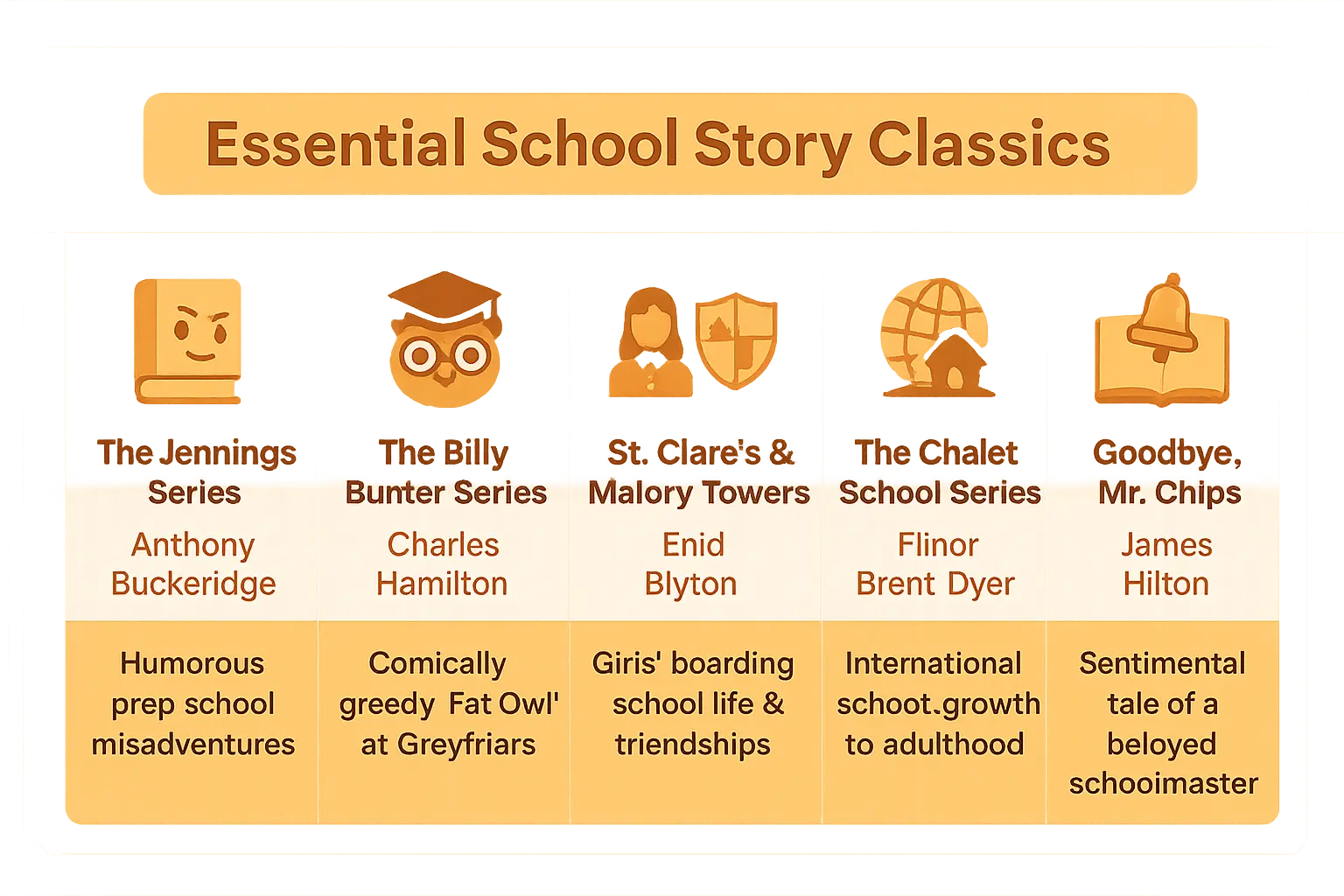
Ever wondered which classic tales shaped the school story genre? 📚 Explore this list of iconic series that turned school life into unforgettable adventures for readers of all ages! 🎒
- The Jennings series by Anthony Buckeridge – Follow a mischievous prep school boy’s escapades. Who could forget “Oylmpic form!” or “putting the p.s. in p.p.”? British humor at its finest 🤣.
- The Billy Bunter series by Charles Hamilton – Meet the “Fat Owl of the Remove,” a gluttonous Greyfriars student whose sausage-stealing antics became legendary. Chaos in a school uniform 🥓.
- St. Clare’s and Malory Towers by Enid Blyton – Track the O’Sullivan and Rivers sisters through boarding school drama, midnight feasts, and fierce friendships. The blueprint for girls’ boarding school tales 🌙.
- The Chalet School series by Elinor Brent-Dyer – A 20-book marathon across decades! From Alpine beginnings to wartime resilience, this series grew girls from students to adults. Proof school stories can be epic sagas 🏔️.
- Goodbye, Mr. Chips by James Hilton – A heartfelt tale about a beloved teacher’s 60-year career. Proof school stories captivate adults too 💔.
Why revisit these? 🤔 They’re time capsules of schoolyard codes, from secret societies to rivalries, still echoing in modern tales like Harry Potter. Who doesn’t love “accidentally-on-purpose” rule-breaking? 🚨
Ready to explore more? Discover their lasting influence on YA novels today! 📖
The Bell Rings Again: Decline And Revival
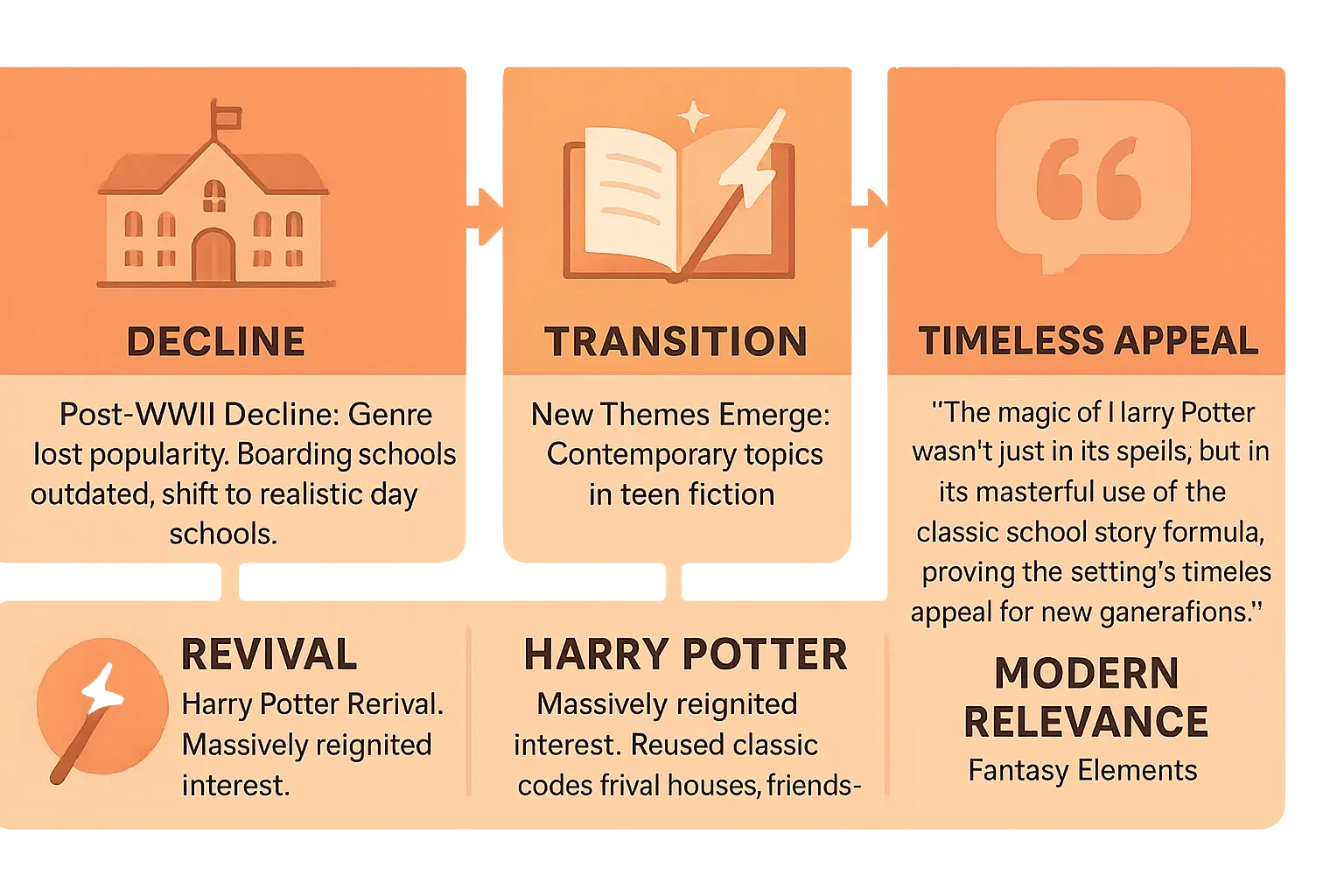
After World War II, school stories entered a slow decline. The once-beloved boarding school setting felt increasingly out of touch as post-war societies prioritized modernity and realism. Families turned toward day schools reflecting contemporary struggles—racial tensions, drug use, and family dynamics—making the cloistered world of private schools seem quaint.
By the 1950s, authors like Geoffrey Trease updated the formula with series like Bannerdale, tackling issues like poverty and social inequality. These stories kept the core themes of friendship and growth but grounded them in relatable, non-fantastical settings.
Then came a magical twist. In 1997, J.K. Rowling reignited the genre with Harry Potter and the Philosopher’s Stone. While set in a fantasy universe, Hogwarts checked every box: rival houses, eccentric teachers, and a found-family dynamic among students. The series proved classic tropes could feel fresh with a dash of magic.
“The magic of Harry Potter wasn’t just in its spells, but in its masterful use of the classic school story formula, proving the setting’s timeless appeal for new generations.”
Research suggests that fantasy elements in stories do not harm learning. A 2021 study found imaginative settings can enhance engagement while maintaining educational value through relatable character arcs and moral dilemmas.
What made Potter revolutionary? It bridged generations. Adults recognized their own schoolyard dramas, while children found a world where their perspectives mattered. The series also embraced diversity—mixed-gender houses, international schools like Beauxbatons—updating the genre for modern readers without losing its nostalgic charm.
Post-Potter, school stories evolved. New titles blend tradition with innovation: diverse casts, real-world issues, and hybrid settings. The genre’s core—exploring identity through shared experiences—remains as relevant as ever, just dressed in fresh robes.
Why school stories still matter today ✨
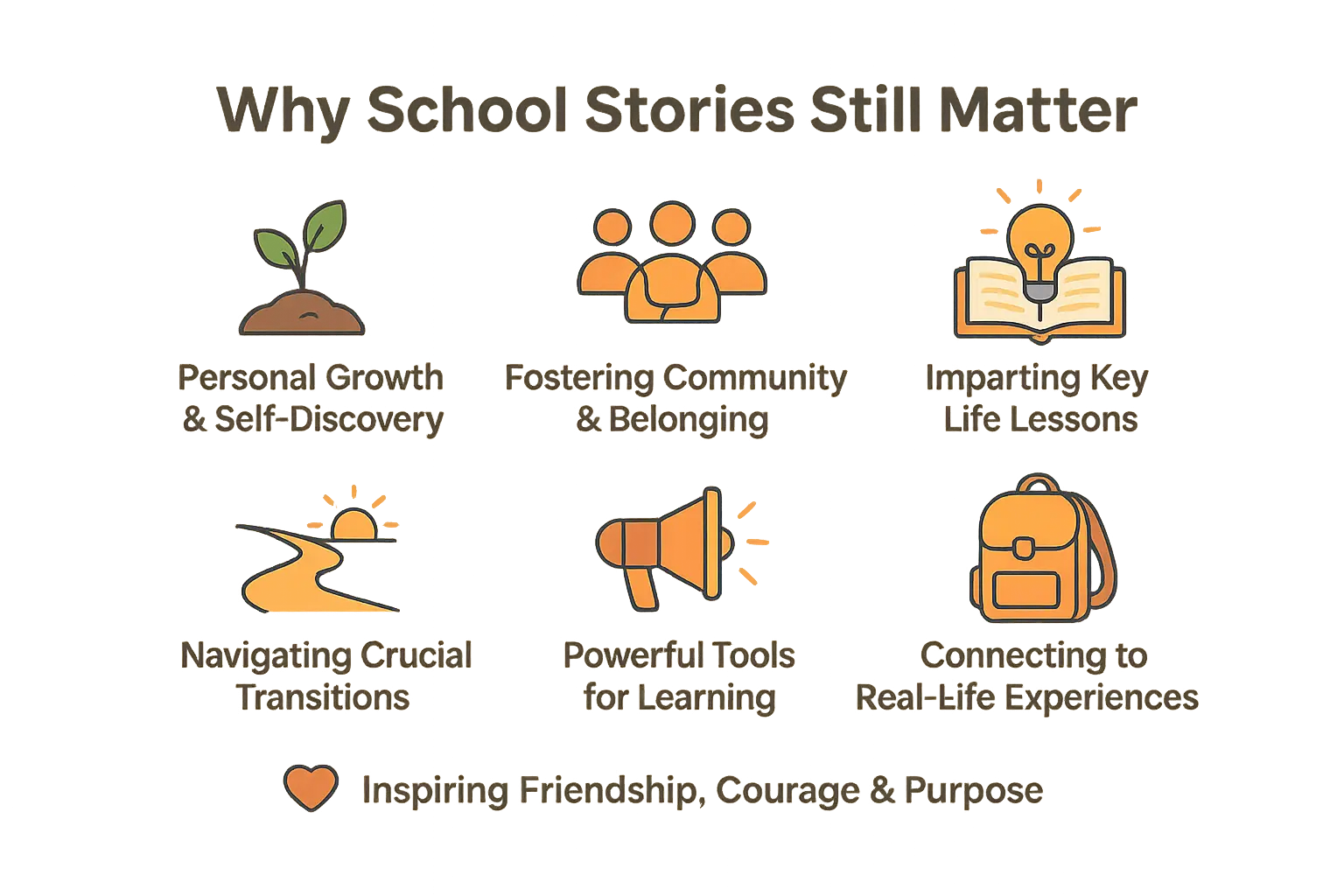
School stories have shaped how generations understand growth and community. From 18th-century moral tales to modern narratives, these stories mirror life transitions. They’re roadmaps for relationships and self-discovery. 📚
Emerging with Sarah Fielding’s 1749 The Governess, school stories set precedents for autonomy and moral learning. By the 19th century, works like Tom Brown’s School Days popularized courage and camaraderie. Subgenres thrived: Angela Brazil’s heroines and Frank Richards’ Billy Bunter series highlighted gender-specific dynamics. 🏫
Though the genre peaked pre-WWII, core themes endure. Modern adaptations like Harry Potter revived their magic, proving stories about belonging remain timeless. They tackle universal struggles—friendship, identity, resilience—to guide young readers. 🌟
Studies show stories simplify complex ideas. A Stanford study highlights how narratives transform abstract lessons into relatable experiences. Tellmestories mirrors this, blending personalized tales for key life lessons and learning experiences. 🧠
Back-to-school moments are prime for these stories. Bonding over new classes or easing first-day nerves, they frame adaptation. Tellmestories’ back-to-school collection offers tailored adventures for smoother transitions and sparking imagination. 🎒
Today’s school stories expand beyond British boarding schools. Reflecting diverse cultures, they retain their essence: guiding kids through change. Connecting past and present, they remind us every generation needs life guides. 🌍
From Malory Towers’ dilemmas to SEL (Social-Emotional Learning) applications, these tales foster empathy, critical thinking, and community. Personalized platforms like Tellmestories keep this legacy alive—proving a good school story is more than fiction; it’s a life lesson. 📖
School stories endure, weaving timeless themes of friendship, courage, and learning with self-discovery. From classics to Harry Potter, they reflect life’s trials while nurturing empathy. Revive old tales or craft new ones—every classroom—and child—holds endless possibilities. 📖✨ Ready to write yours? (60 words)
FAQ
What are some short story ideas for high school?
High school stories thrive on relatable drama and growth! Think friendships tested by secrets, underdog sports teams defying odds, or students solving a mystery in hidden school tunnels. Add twists like a new student hiding a shocking past or a teacher with a secret passion. For extra flair, include midnight adventures in dorms or rivalries between school houses. 🎓
What is the most famous school in history?
Hogwarts School of Witchcraft and Wizardry from Harry Potter steals the spotlight! 🪄 While fictional, it’s globally iconic, blending magic with classic school themes like friendship and courage. Real contenders include Eton College (royal alumni!) and Harvard University (elite academics since 1636). Hogwarts wins for pure cultural impact, though!
Why do I love my school (10 lines)?
I love my school because… ❤️ – It’s where I met my best friends 💞 – Teachers who actually care 😊 – That epic football game we won in OT 🏆 – Secret hideouts only we know about 🕵️♀️ – Laughter during study breaks 📚✨ – Traditions that make us feel connected 🎉 – That one teacher who changed my life 🌟 – The smell of the cafeteria (nostalgia!) 🥪 – Every “we did it!” moment after group projects 📋 – Because it’s my second home 🏡
What is a school story?
Think of a school story as a world where classrooms are kingdoms and friendships rule! 🏰 It’s fiction set in schools (often boarding schools), focusing on life between classes—like midnight feasts, rivalries, or standing up to bullies. From Tom Brown’s School Days to Harry Potter, these tales mirror growth, loyalty, and the chaos of youth. Classic formula? Friendship + drama + a dash of mischief. 📚
What is a good story topic?
Good topics? Think timeless! 🔄 Here’s the lowdown: – Friendship: Bonds that survive secrets or betrayal 🤝 – Bravery: Standing up for what’s right 🦸♂️ – Secrets: Hidden passages or a teacher’s mysterious past 🗝️ – Firsts: First crush, first heartbreak 💔 – Rebels: Challenging traditions (think Harry Potter vs. rules) ✊ Check out friendship themes for deeper dives!
What is a perfect short story?
Short stories? Nail the basics: – Hook: Start with a mystery or a “what if?” moment 🎣 – Characters: Relatable heroes—even a mischievous kid like Jennings 🧒 – Conflict: Rivalries, stolen exams, or a midnight escape 🕛 – Resolution: End with growth (e.g., a bully becoming an ally) 🌱 Bonus points if it leaves readers craving a sequel! 💡
What is the top 1 best school?
Subjective, but Hogwarts dominates pop culture! 🌟 For real-world schools, Eton College (UK) and Phillips Academy Andover (US) top lists. Hogwarts wins for its mix of magic and universal themes—proving even wizards need friendship and courage! 🪄📚
What are the 9 great schools?
Mix of real and fictional giants: – Hogwarts (obvi!) 🪄 – Eton College (UK elite) 👑 – Harrow School (Churchill’s alma mater) 📖 – St. Paul’s School (UK academic powerhouse) – Phillips Exeter Academy (US Ivy feeder) 🌟 – Choate Rosemary Hall (prep for future leaders) 🎓 – Greyfriars (Billy Bunter’s antics) 😏 – Malory Towers (Enid Blyton’s girls’ school) 🏰 – Brookfield (Mr. Chips’ legendary classroom) 📖
Why is Harvard so hard to get into?
Brutal stats, folks. Harvard accepts just 3-4%! 🚨 They seek: – Sky-high grades + extracurriculars (Olympians, entrepreneurs) – Essays that sparkle ✨ – Recommendations that scream “future leader” 🎯 – A sprinkle of “je ne sais quoi” (aka luck). Over 40,000 apply yearly for ~2,000 spots. Ivy League? More like Ivy gauntlet! 🎓