The essential takeaway: Science stories blend fun and learning, using narratives like Sid the Science Kid’s gravity experiments to simplify complex concepts. NASA research shows 78% of kids grasp science faster this way, sparking curiosity and transforming abstract ideas into thrilling adventures that make the universe feel like a playground.
Ever found yourself wondering how to make science exciting for your child? 😩 Science stories for kids are here to turn “why?” into “whoa!”—no lab coat required! These tales blend mind-blowing facts with epic adventures, from gravity-defying space missions to secret lives of bugs in your backyard. Imagine sparking curiosity through stories that don’t just teach, but transform bedtime into a launchpad for discovery. Think Sid the Science Kid’s pollination adventure or a robot fixing satellites on Mars—each tale turns complex concepts into giggles and “aha!” moments. Ready to unlock how stories about curious ants, glowing robots, or Mars-bound inventors can turn little “hows” into big “ah-has”? 🚀
Why Are Science Stories A Game-Changer For Your Child’s Curiosity?
Ever wondered how to make gravity or chemistry feel less intimidating for your 5-year-old? 🌟 Science stories turn “boring facts” into thrilling adventures where planets orbit like dance partners and molecules become tiny builders. Ditch glazed eyes – embrace wide-eyed wonder! 💡
Traditional explanations often drown kids in jargon. Enter science stories: magic portals where kids don’t just learn about space – they become astronauts navigating black holes. They don’t memorize anatomy – they help a cartoon character fix a broken arm. Concepts stick when kids live them through relatable characters. 🧩
Take Sid the Science Kid’s Gravity and Weightlessness episode – kids “float” alongside Sid’s ball-defying experiment. Or explain pollination through a bee spreading “fairy dust” in a magical garden. Stories transform abstract ideas into tangible journeys.
- Critical thinking grows via story predictions
- Practical learning through character experiments
- Real-world links show science in daily adventures
Here’s the secret: these stories aren’t just bedtime tales. They’re blueprints for future scientists. When kids see science as fun quests, curiosity fuels lifelong learning. 🚀
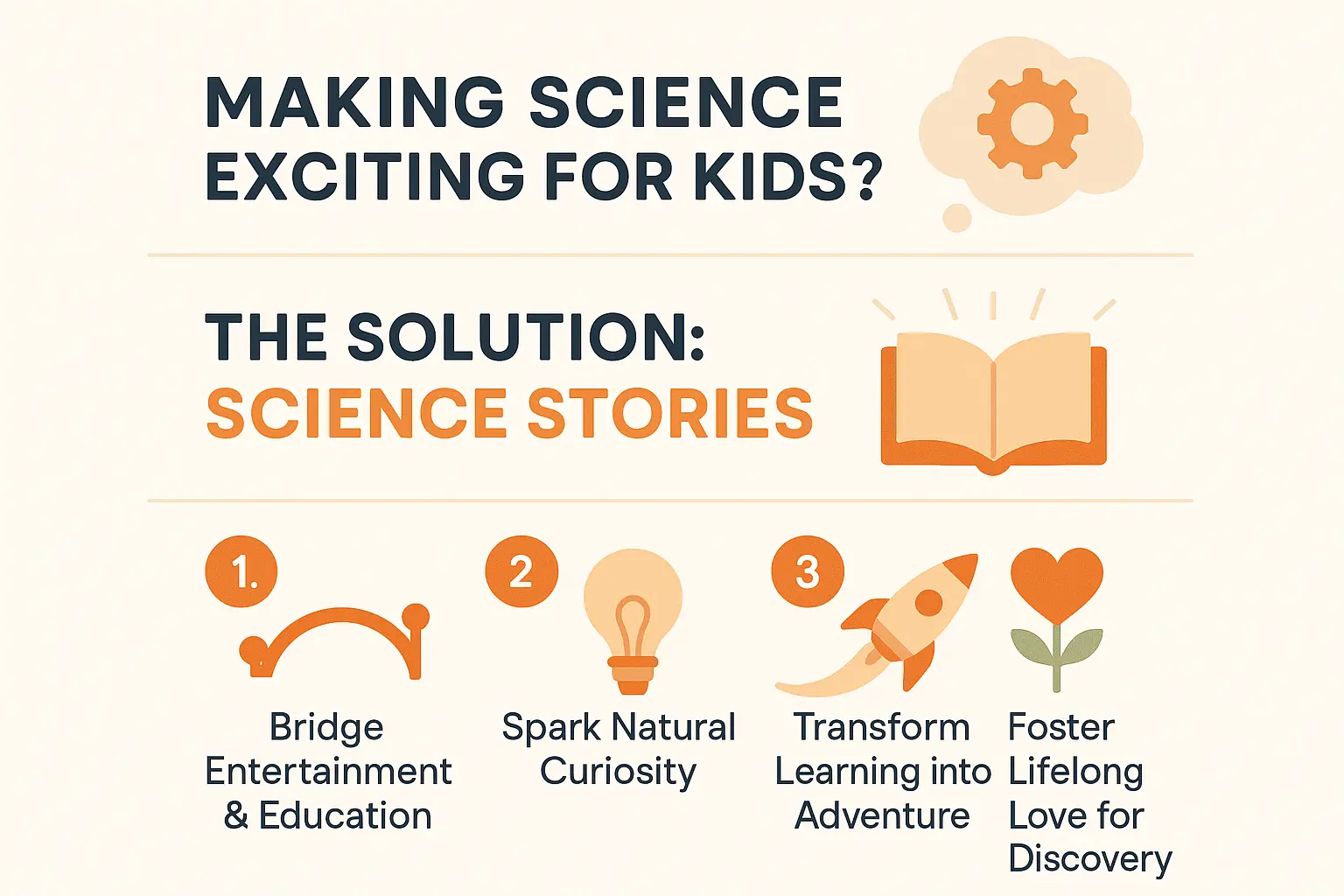
What exactly are science stories for kids?
Making the complex simple and fun
Science stories for kids turn tricky topics like space, human anatomy, and chemistry into adventures kids can’t wait to dive into. Imagine explaining gravity through Sid the Science Kid’s quest to make a ball float, or teaching pollination by following a curious bee. 🐝
These stories use engaging narratives to break down complex ideas. For example, in “Gravity and Weightlessness,” Sid and his friends try to defy gravity, making the concept relatable. Similarly, a story about a robot needing fuel could introduce viscosity through hands-on experiments. The goal? No jargon, just fun and curiosity. 🌌
The benefits of learning through stories
Kids absorb science through stories in ways that stick. Research shows storytelling boosts memory, empathy, and critical thinking. Stories transform abstract ideas into relatable adventures, making learning feel like play. 🧠
Science stories transform abstract concepts into relatable adventures, allowing children to grasp complex ideas not as dry facts, but as part of an exciting journey of discovery.
For parents, this means turning bedtime into a science lesson without the struggle. Need examples? Exploring a great collection of science stories can show how a robot’s space mission explains planetary orbits, or how a melting ice cube becomes a lesson in phase changes. 🧊
Kids stay curious, ask questions, and connect science to their daily lives. And with services like Tellmestories, creating personalized tales—like a child becoming the hero of a Mars mission—is just a WhatsApp voice note away. 🚀
A Universe Of Tales: Exploring Different Kinds Of Science Stories 🌌
Adventures In Space And Beyond 🪐
What if bedtime became a launchpad for cosmic discovery? 🚀 Science stories turn intimidating topics into thrilling quests. Imagine your child joining Hayley on “Hayley Rides Into Space” – a tale where rocket fuel calculations feel like solving a puzzle. These narratives make planetary orbits and space stations as exciting as video game levels.
Even NASA uses storytelling! NASA’s own learning resources for kids show how gripping narratives simplify concepts like solar storms or rover missions. Picture your little one learning about Mars’ atmosphere through a character who breathes in its thin air during a fictional expedition!
The Wonders Of The Living World
Did you know ants use “antennae language”? 🐜 Sid the Science Kid’s “Ants” episode turns bug behavior into an alien communication mystery. These stories uncover nature’s hidden rules while keeping kids hooked through character-driven problem-solving.
From bees becoming pizza couriers in “Pollination” to isopods starring in “Rolie Polies,” science tales transform ordinary creatures into fascinating characters. Children absorb lessons about food chains and plant growth without realizing they’re building biology foundations – all while cheering for Sid’s latest discovery!
Everyday Science Mysteries
Why does syrup flow slower than water? 🥞 Sid’s “Optical Illusions” episode proves physics can be pancake-sized fun. These stories turn kitchen-table moments into “aha!” revelations about viscosity, light refraction, or how baking soda + vinegar becomes a mini-volcano.
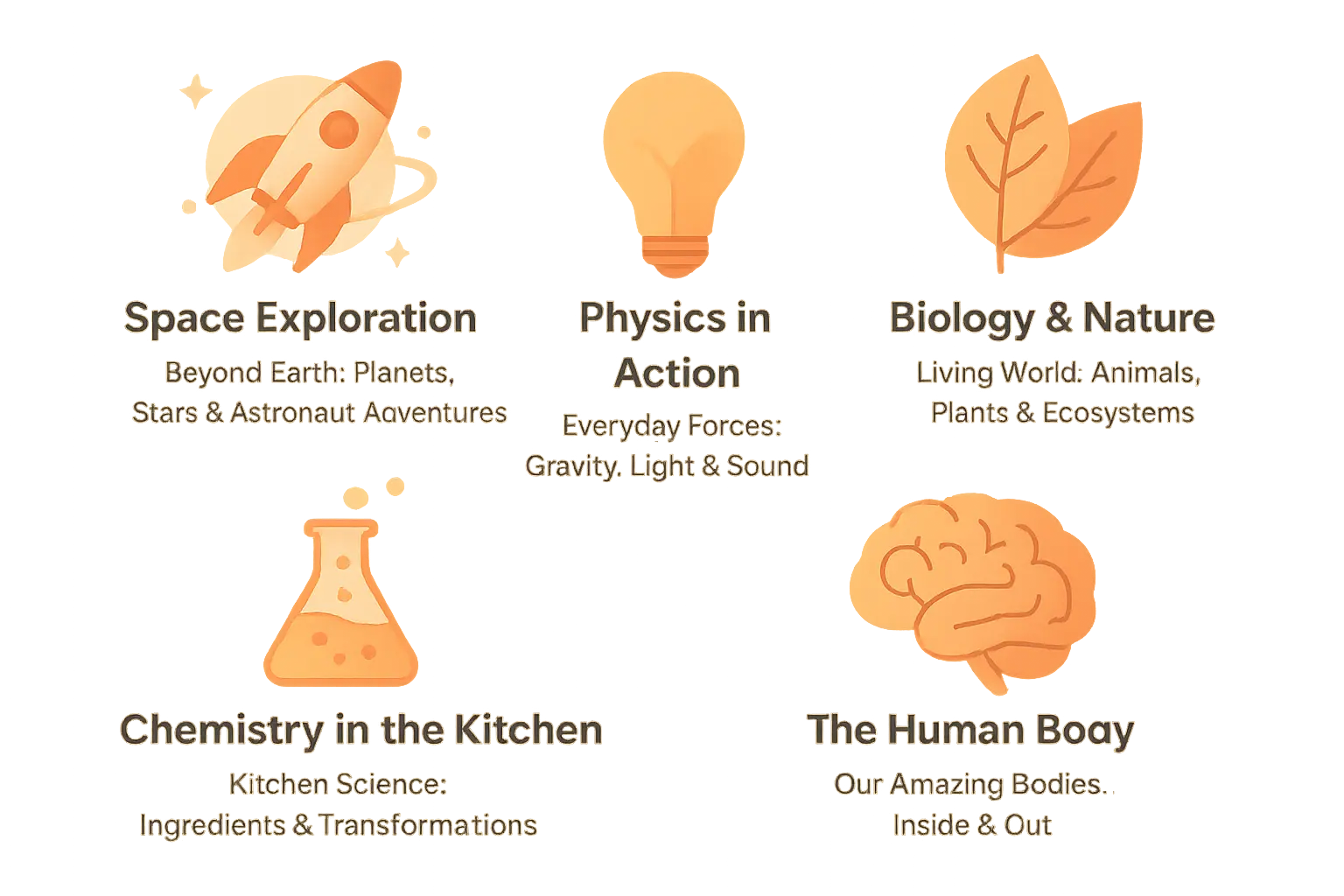
- Space Exploration: Learning about planets, stars, and what it’s like to be an astronaut.
- Biology & Nature: Discovering how animals communicate, plants grow, and ecosystems work.
- Physics in Action: Understanding concepts like gravity, light, and sound through fun, story-driven experiments.
- Chemistry in the Kitchen: Exploring how simple ingredients mix and change to create something new.
- The Human Body: A journey inside ourselves to see how our amazing bodies work.
Ready to make science magical? Making science fun starts with stories that turn snack time into chemistry class and puddle-jumping into physics. Want to personalize learning? Just send a voice note about your child’s favorite animal – the AI remembers preferences to create stories where they become the hero exploring how octopuses change color or why sloths move so slow. These narratives don’t just teach – they turn curiosity into lifelong superpower!
Journeys With The Giants: Stories About Famous Scientists And Inventors
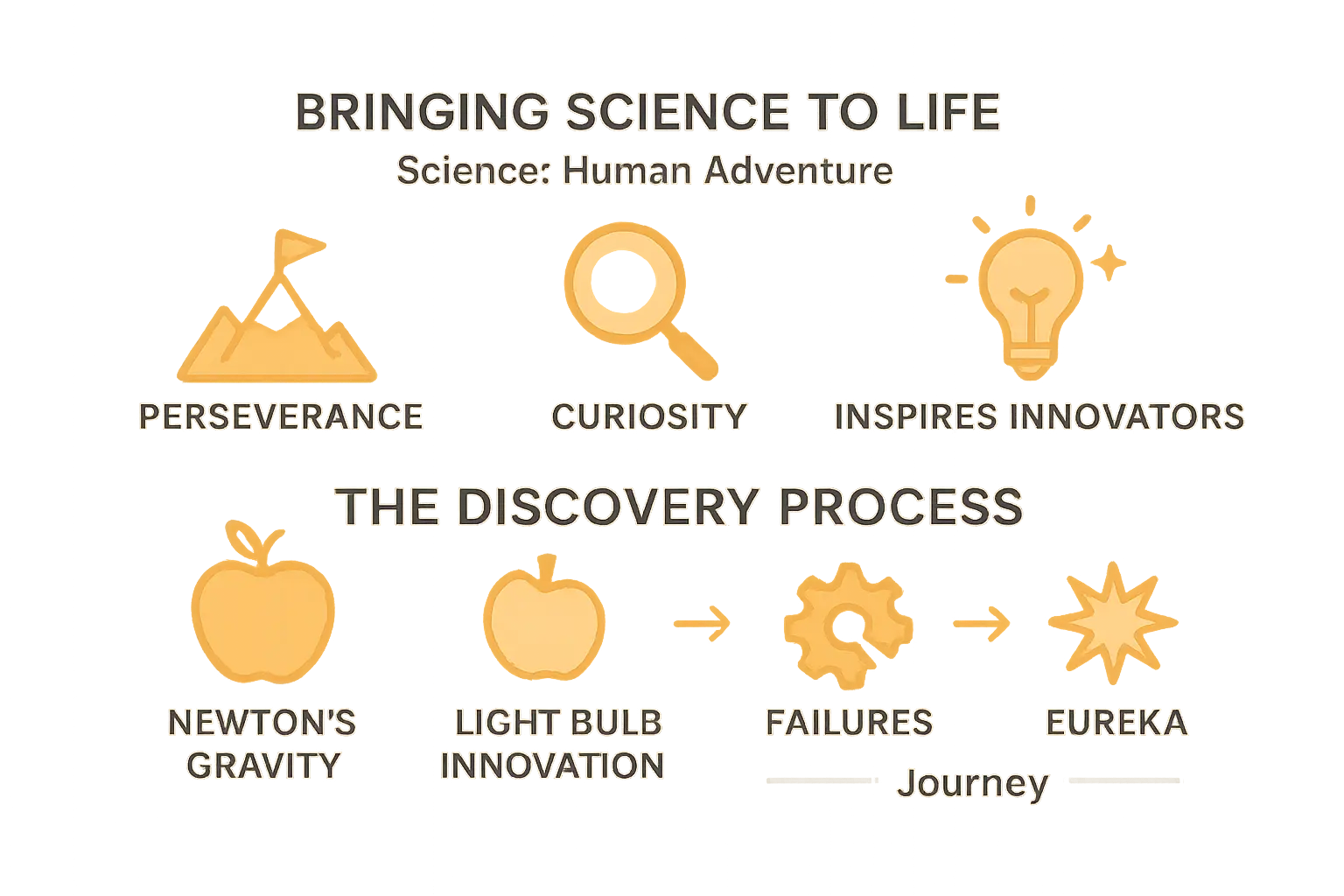
Bringing History To Life
Science isn’t just equations and lab coats – it’s a human adventure! 🌟 Take Marie Curie’s journey: a Polish girl defying odds to study physics in Paris, later discovering radium while caring for her sick husband. Her story teaches kids that science comes from real people’s passions, not just textbooks. She became the first woman to win a Nobel Prize (in Physics, 1903) and later won another in Chemistry (1911), showing that hard work pays off even when facing tough times.
Meet Ada Lovelace – daughter of a poet and mathematician – who saw poetry in numbers. When she helped engineer Charles Babbage’s “thinking machine,” she wrote the world’s first computer program in 1843! 🧠 Her story shows kids that creativity powers innovation, whether you’re writing code or composing poems. She imagined machines doing more than calculations – predicting modern computing by 100 years! Her “science poetry” approach proves STEM needs imagination too.
From A Falling Apple To A Glowing Light Bulb
Ever wondered what inspired Newton’s gravity theory? Legend says an apple bonked his head! 🍎 His real journey was grittier: years of math struggles before proving gravity affects everything from falling fruit to orbiting planets. Parents can share these inspiring STEM tales showing science’s messy, magical process. Imagine telling kids how he watched apples fall while hiding from plague – turning isolation into scientific breakthroughs!
Thomas Edison’s 1,000+ failed light bulb attempts teach another lesson: “I didn’t fail – I found 10,000 ways that didn’t work!” 🔦 His bamboo filament breakthrough after 14 months shows progress needs persistence. These stories become bedtime adventures when told through WhatsApp voice notes, letting kids imagine themselves as young Edison or Curie. Picture describing how he tested 6,000 materials before finding the perfect carbonized bamboo filament – a perfect lesson about never giving up!
Beyond The Facts: What About Science Fiction Stories For Kids?
Science Fact Vs. Science Fiction: What’s The Difference?
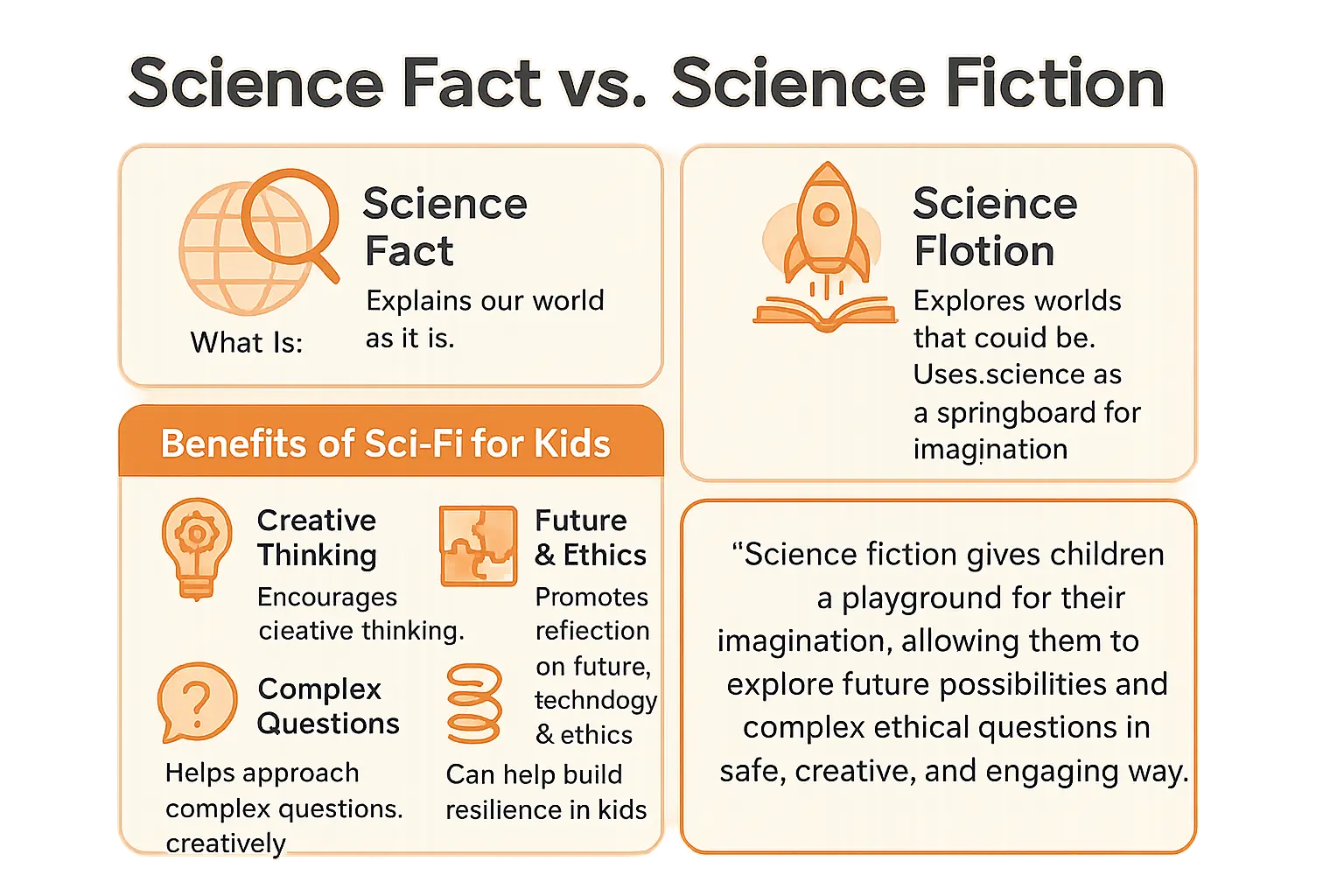
Science facts explain reality – like how ants work or why the sky changes color. 🌍 They follow strict scientific principles and focus on observable truths. These stories help children understand the world through verifiable information and real-life applications.
Science fiction explores hypothetical worlds. It uses real science as a springboard for “What if?” scenarios – like imagining talking robots or life on Mars. 🚀 For example, while a factual story might explain gravity through a falling apple, a fictional version could show astronauts navigating zero gravity on a space station. Both approaches teach scientific principles, but fiction makes abstract concepts tangible through relatable characters and adventures. Consider how Sid the Science Kid investigates topics – science fiction uses similar question-driven approaches in imaginative settings.
Fueling Imagination And Critical Thinking
Science fiction develops creative thinking by letting kids explore impossible scenarios safely. When children hear tales about alien ecosystems or robot friends, they build neural pathways for innovative problem-solving. 🧠 These stories help children grasp complex topics like space exploration or human anatomy through engaging narratives that make learning feel like an adventure.
Research from Berkeley shows these stories help kids process emotions through fictional characters. 🎭 By projecting themselves into adventures, children experience challenges and victories vicariously. This emotional engagement builds empathy while maintaining educational value.
“Science fiction gives children a playground for their imagination, allowing them to explore future possibilities and complex ethical questions in a safe, creative, and engaging way.”
These stories also boost analytical skills. When kids see characters solving futuristic problems, they start thinking critically too. They learn to ask questions like “How would I fix this?” or “Why did this happen?”. This mirrors how scientists approach real-world challenges, but in a format that feels like play rather than work.
Try it! Ask: “What if your pet could talk?” or “What if rainbows had secret powers?” 🌈 These questions spark cognitive flexibility while keeping science exciting. You might be surprised how quickly kids connect these imaginative leaps to real scientific concepts like animal behavior or light refraction.
How to choose the perfect science story for your child
Science stories can turn complex concepts into exciting adventures for kids. The key? Choosing tales that match their curiosity and developmental stage. Let’s explore how to find the perfect fit!
Matching stories to their interests and age
Start by observing what fascinates your child. Are they obsessed with space rockets, eager to learn about animal habitats, or asking questions about why the sky is blue? Use these passions as your guide. For ages 3-6, pick stories with vivid illustrations and simple explanations—like how bees help flowers grow. Older kids (7-10) enjoy stories with real-world connections, such as how astronauts live in space.
Turn their questions into story prompts. If they wonder how rain forms, choose a tale about cloud adventures. This approach makes science feel relevant and sparks deeper exploration.
A quick guide to science story types
| Story Type | Best for… | Key Benefit |
|---|---|---|
| Factual Science Stories (e.g., “Why do bees buzz?”) | Curious kids who ask “Why?”. Ages 3-7. | Explains real-world phenomena in a simple, memorable way. |
| Biographical Stories (e.g., “The story of Marie Curie”) | Inspiring future inventors and thinkers. Ages 6-10. | Shows that science is a human journey of perseverance and discovery. |
| Science Fiction Stories (e.g., “A robot’s adventure on Mars”) | Dreamers and imaginative kids. Ages 5-10. | Boosts creativity, problem-solving, and forward-thinking. |
- Start with their questions: What are they curious about right now?
- Look for engaging characters: A friendly robot or curious animal can make any topic fun.
- Consider interactive elements: Stories that ask questions or suggest activities are great for engagement.
- Don’t be afraid to mix it up: Try a story about space one night and biology the next!
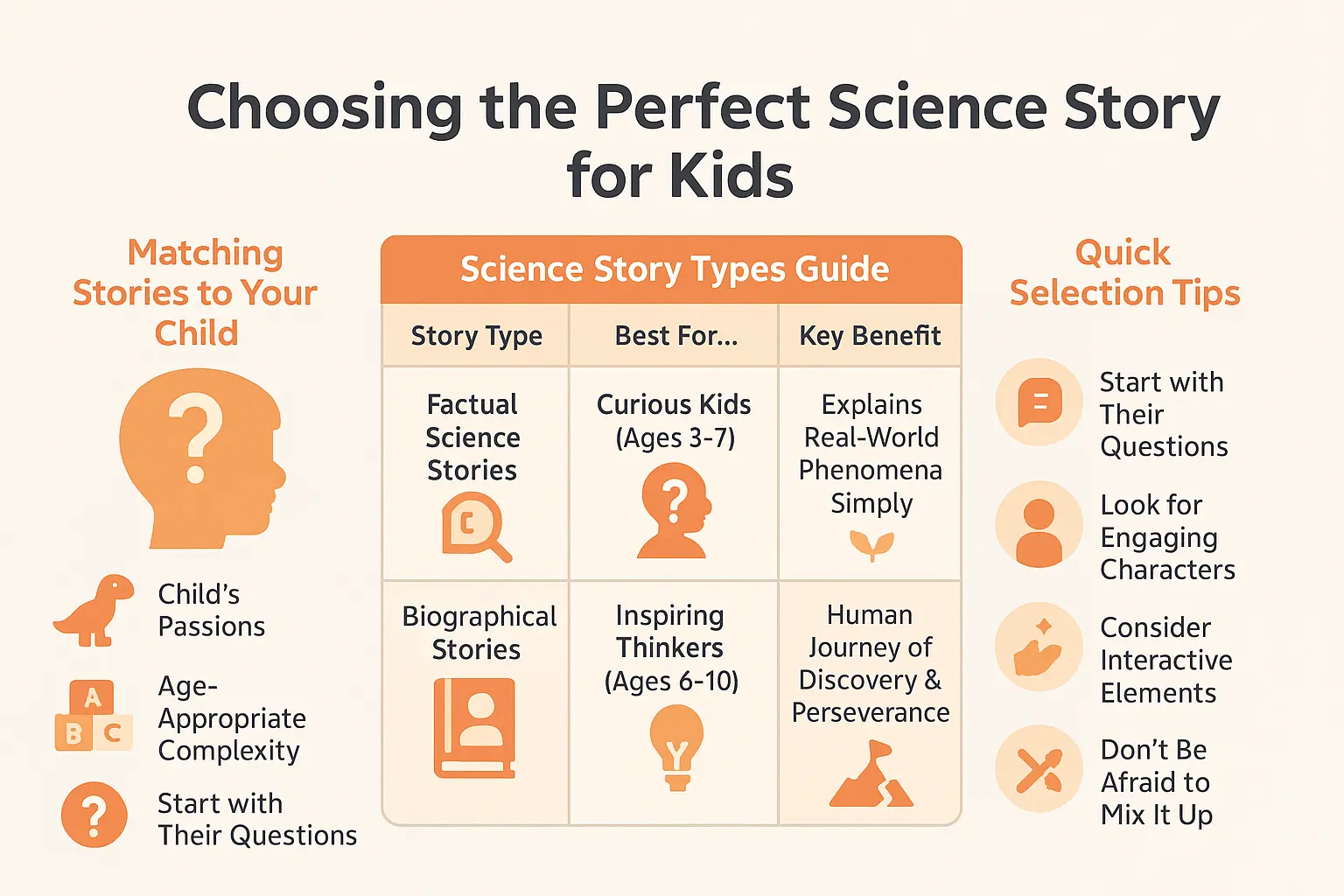
By aligning stories with your child’s interests and age, you’ll make science exciting and accessible. Whether it’s factual tales, biographies, or sci-fi adventures, the right story turns learning into a memorable journey. Ready to explore the universe of science together? 🚀
Ready to spark a love for science? 🚀
Science stories for kids transform tricky topics like space or chemistry into thrilling adventures. Imagine your child zooming through the solar system as a brave astronaut or shrinking to explore the microscopic world inside their body! 🌌
Popular series like Sid the Science Kid use playful narratives to explain concepts. Sid’s investigation about ants reveals how teamwork works in nature. His experiments with gravity or water states turn everyday moments into learning opportunities. Even fictional tales like Hayley Rides into Space blend creativity with scientific principles, sparking curiosity without overwhelming young minds.
Research shows stories about scientists’ struggles—like Einstein’s early math challenges—inspire kids more than tales of effortless genius. These narratives humanize science, showing kids that mistakes are part of discovery. 🧪
What if your child could star in their own space adventure or solve a mystery using chemistry? With personalized storytelling, a voice note sent via WhatsApp becomes a custom tale where they’re the hero. No downloads—just instant, interactive stories that adapt to their interests and grow with them.
- Science stories make learning fun and accessible.
- Tales about real scientists provide powerful inspiration.
- Science fiction is a fantastic tool to boost imagination.
- Personalizing stories to a child’s interests is the key to engagement.
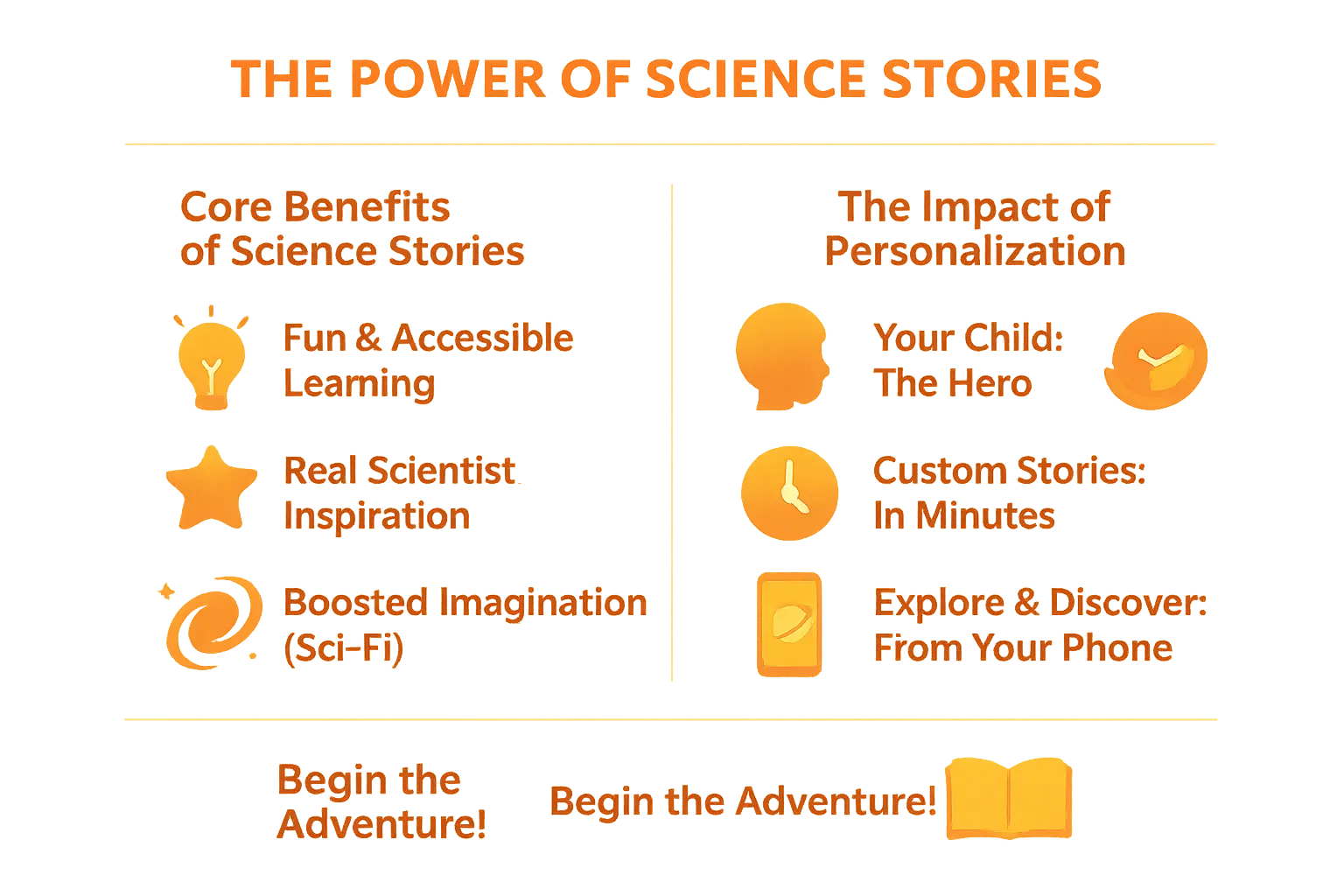
The next great discovery could start with a single story. Time to begin the adventure! 🚨
Science stories turn bedtime into a launchpad for curiosity, blending fun with facts. They spark wonder through real-world marvels, inspire with tales of pioneers, and let imaginations soar beyond stars and labs. Ready to transform “why?” into “wow!”? 🌟✨ The next Einstein might start with a story tonight!
FAQ
What Makes a Science Story Truly Great for Kids?
A great science story for kids blends fun and facts! 🌟 It uses relatable characters, simple language, and exciting adventures to explain scientific concepts. Think of stories like Sid the Science Kid explaining gravity by tossing a ball in the air or Hayley Rides Into Space making rocket science feel like a space adventure. The key? Making complex ideas feel magical yet meaningful—no jargon, just curiosity-driven fun!
What Are Top Science Fiction Books Kids Love?
Kids adore sci-fi books like Kid Scientists by David Stabler, where real-life science heroes like Marie Curie or Neil deGrasse Tyson become characters in quirky childhood stories. For fictional tales, Robot in Space (a robot’s mission to find Melody) or My Terrific Spaceship (exploring rocket countdowns and zero gravity) are hits! These books mix imagination with STEM basics, sparking wonder while sneaking in learning.
What’s the World’s Most Beloved Kids’ Story?
While opinions vary, classics like The Very Hungry Caterpillar (biology basics!) or Where the Wild Things Are (emotional exploration) top many lists. For science-themed tales, Hayley Rides Into Space—where a kid becomes astronaut Sally Ride—is a favorite! 🚀 These stories win because they’re simple, emotional, and relatable, turning abstract ideas into playful journeys.
What Science Basics Should a 5-Year-Old Know?
At 5, focus on hands-on concepts: – Living vs. non-living things (plants grow, rocks don’t!). – Simple physics (push/pull, floating/sinking). – Weather basics (rain, clouds, seasons). – Counting and patterns (e.g., “How many petals on this flower?”). Use stories like Sid the Science Kid: Ants to explain teamwork in nature or Primary Colors to mix paints. Keep it playful—no exams, just “aha!” moments!
What Defines a Science Fiction Story for Kids?
Sci-fi for kids asks “What if?” 🤔 It blends real science with wild imagination—like a robot friend exploring Mars or a time-traveling scientist. Unlike factual stories, it’s not about “how things work” but “what could happen.” Think Robot in Space (tech + space adventures) or stories about talking animals solving mysteries. It’s fact-meets-fantasy, teaching creativity and problem-solving!
Which Sci-Fi Stories Captivate Young Minds?
Great sci-fi for kids sparks curiosity and giggles! 🪐 Try: – Robot in Space: A robot’s mission to find his human pal Melody. – Magic School Bus: Lost in the Solar System: A class trip to Saturn (with silly science!). – Ada Twist, Scientist (by Andrea Beaty): A curious girl’s experiments in creativity. These stories balance wacky plots with STEM sparks, showing science isn’t just labs—it’s everywhere!
What Are 3 Iconic Sci-Fi Examples for Kids?
Check out these crowd-pleasers: 1. The Wimpy Kid Do-It-Yourself Book (Jeff Kinney): Mixes humor with DIY science projects. 2. Zita the Spacegirl (Ben Hatke): A girl’s intergalactic quest with robots and aliens. 3. The Future With Tim (by Nick Arnold): Explains tech like AI with laugh-out-loud facts. Bonus? These stories make science feel like an adventure, not homework!
Is Harry Potter Considered Science Fiction?
Nope! 🧙♂️ Harry Potter is fantasy, not sci-fi. While both genres explore “what if?” scenarios, sci-fi is rooted in science (even futuristic tech), whereas fantasy uses magic or mythical creatures. Harry’s wand? Pure fantasy! But hey, both genres boost creativity—so let kids enjoy both worlds!
Why Is Sci-Fi Perfect for Young Explorers?
Science fiction isn’t just fun—it’s a brain booster! 🧠 It: – Sparks creativity (imagine a world with floating cars!). – Teaches problem-solving (how would you fix a broken spaceship?). – Encourages ethical thinking (“Is AI safe?”). Books like Zita the Spacegirl or Kid Scientists (where Einstein’s childhood mishaps are hilarious) show that science is about asking questions, not just answers. So yes, sci-fi is super good for kids! 🌈