
The key takeaway: Breaking down complex concepts into clear steps (like HowStuffWorks’ mission to explain everything from car engines to space) gives us a universal recipe for understanding. This approach empowers people to grasp challenging topics, demystifying life’s mysteries. A standout example? Alcoholics Anonymous’ 12-step method, which uses spiritual principles to guide personal transformation—proving that clarity often lies in simplifying the overwhelming. 💡
Ever caught yourself staring at something, wondering “how does this even work? 🤔” You’re not the only one! This article peels back the curtain on how it works—whether it’s decoding 12-step recovery programs, AI-powered storytelling, or even howstuffworks.com’s knack for explaining life’s mysteries. We’ll break down how breaking down complexity into manageable pieces transforms confusion into clarity, turning “I don’t get it” into “Oh, I totally get it!” Spoiler: it’s not magic—it’s method. From tech to personal growth, you’ll see why understanding the “how” makes everything from apps to recovery feel less intimidating. Ready to unlock the secrets hiding in plain sight? 🔍✨
What Does "How It Works" Really Mean?
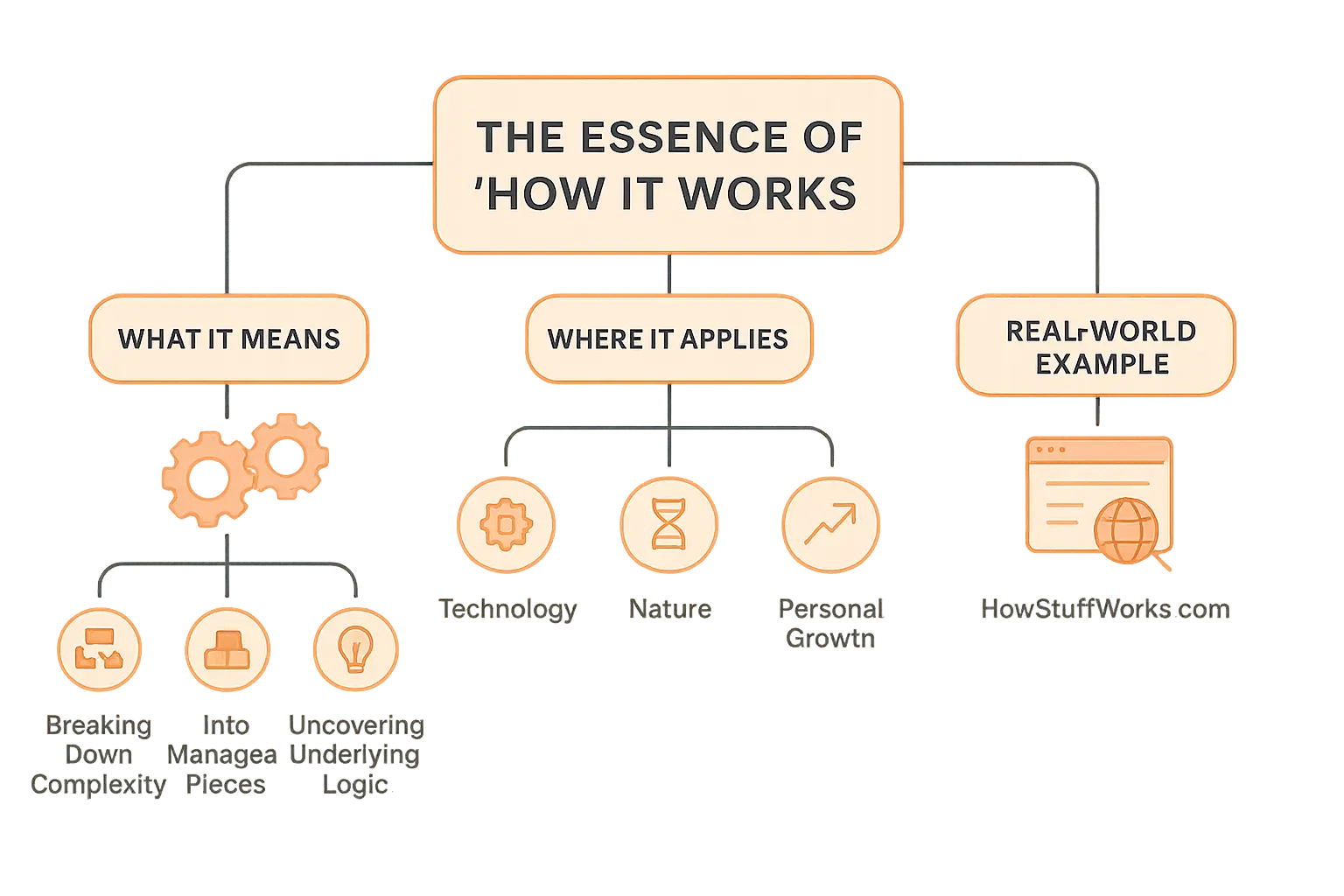
Ever caught yourself staring at your phone and thinking, how does this tiny machine do so much? 🤔 That’s the how it works instinct kicking in. It’s human nature to crave clarity! At its heart, this concept is about breaking down the overwhelming into manageable pieces. Like when you learn to ride a bike: you don’t just “pedal and balance” out of nowhere. You start with training wheels, then practice steering, then… voilà! Suddenly, it clicks. That’s what “how it works” does—it turns confusion into steps you can actually follow.
Take HowStuffWorks, for instance. Ever wondered why your toast lands butter-side down? They’ve got a whole article on gravity and probability. Or how about the science behind why cats hate water? Yep, they’ve got that too. From explaining car mufflers to decoding the “5-second rule” for dropped food, they make the weirdly specific and the wildly complex feel approachable. National Geographic joins the party with visuals: watch a submarine dive, see how 3D printers layer magic, or geek out over how lava lamps swirl. It’s like having a pocket-sized explainer for everything under the sun 🌞.
But here’s the plot twist: the #1 “how it works” searches aren’t about gadgets. Turns out, people are Googling a book chapter on… personal growth. Yep, the same people who want to know how Wi-Fi works also need help fixing what’s broken inside. Imagine that! We’ll unpack how this guide—hint: it involves a “higher power” and zero carbs—became a viral fix for life’s messier problems. Stay tuned! 📖✨
A powerful example: the “how it works” of 12-step programs
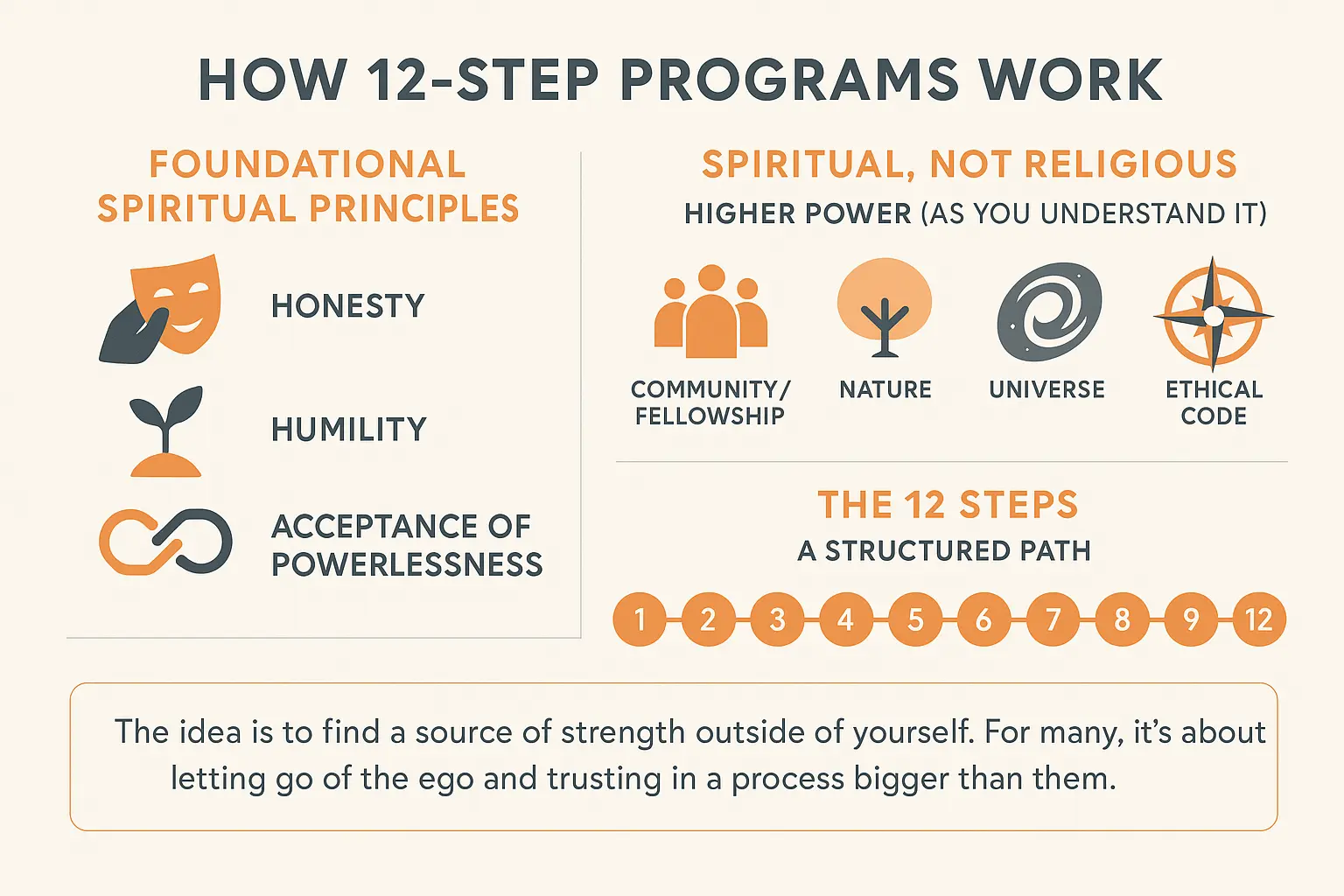
Let’s explore a proven system: 12-step programs like Alcoholics Anonymous. They work by tackling daily habits and deeper character growth. With 85+ years of success, their strength lies in combining practical action with personal development.
The idea is to find a source of strength outside of yourself. For many, it’s about letting go of the ego and trusting in a process bigger than them.
Spiritual principles, not religious rules
Here’s a key point: 12-step programs aren’t religious. The Higher Power concept adapts to your beliefs. It could be traditional religion, the group’s support (“the Program”), nature, or universal ethics. What matters? It creates a growth framework.
When addiction takes hold, willpower isn’t enough. These steps focus on progress, not perfection. Think of learning a new skill – start small and build momentum. Whether you’re religious or not, the goal is finding your personal anchor.
- We admitted being powerless over alcohol – lives had become unmanageable
- Came to believe a Power greater than ourselves could restore sanity
- Turned our will and lives to God as we understood Him
- Admitted wrongs to God, ourselves, and another person
- Willing to have defects removed
- Humbly asked for shortcomings to be eliminated
- Created harm list and made amends
- Continued personal inventory and admitted mistakes
- Sought spiritual connection through prayer and meditation
- Made amends directly where possible
- Improved conscious contact with our Higher Power
- Shared experience to help others after spiritual awakening
Why this method stands the test of time
These steps aren’t just for crisis moments – they’re daily tools. Practice step 5 by admitting mistakes to a friend (honesty + humility). Use step 10 when facing setbacks: admit errors, fix what you can, move forward with integrity.
The real power? Spiritual principles translate to concrete actions. Letting go of control (step 3) means breaking compulsive patterns – like checking your phone constantly or making empty promises. It’s about gradual, sustainable change rather than quick fixes.
Spiritual principles work because they’re adaptable. Step 1 teaches acceptance, step 4 builds courage, step 8 fosters good will, with each step building on the last to create lasting change. Think of it like learning to ride a bike – wobbly at first, then second nature.
The universal recipe for any “how it works” explanation
So we’ve seen a really deep example. But what do all “how it works” explanations have in common?
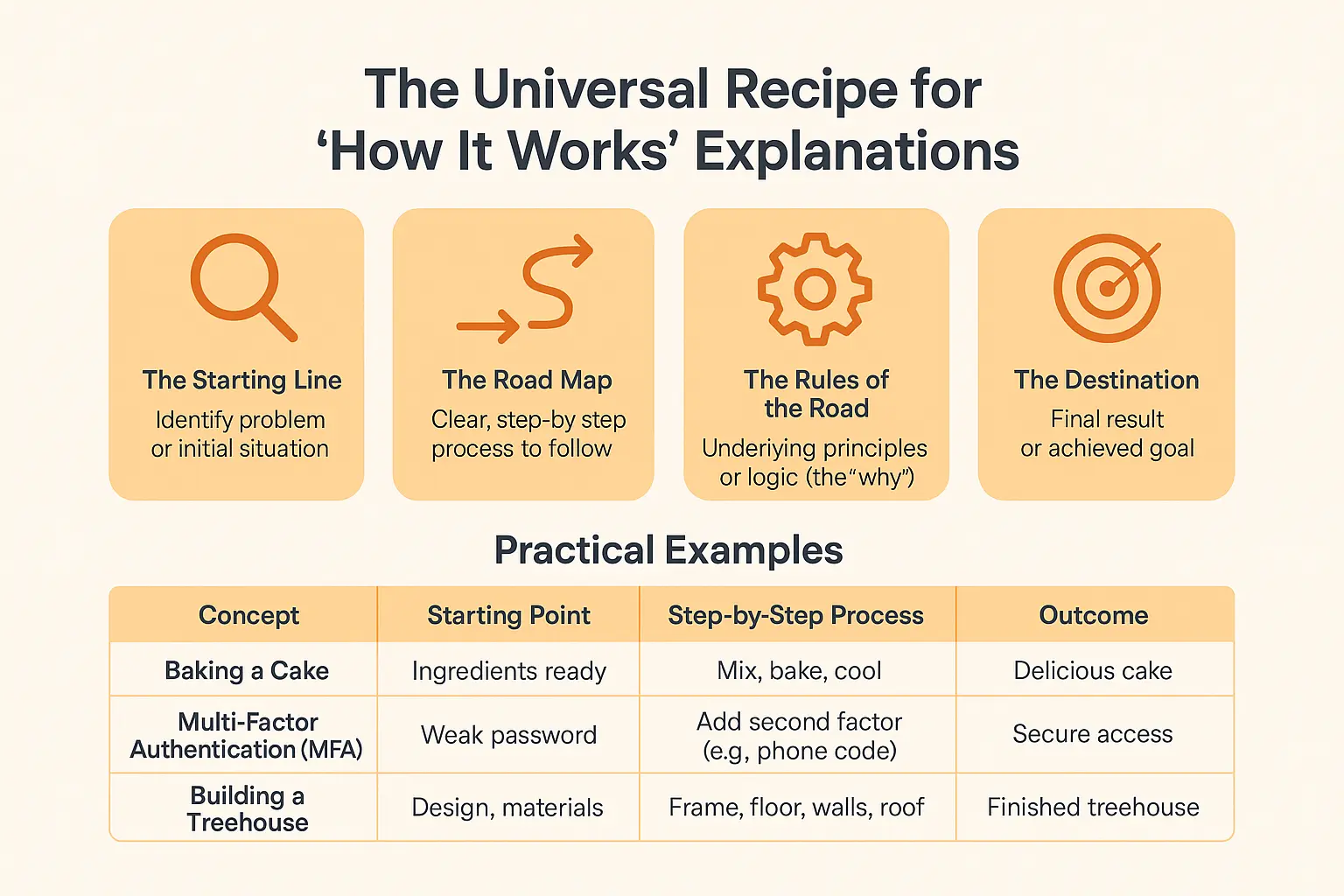
Let’s break down the universal recipe that makes these explanations stick:
- The starting line: Identifying the problem or initial situation. This sets the “before” scenario to create immediate context.
- The road map: Clear step-by-step process. This gives readers a logical progression they can follow without confusion.
- The rules of the road: Explaining the underlying principles. This connects dots to make the “why” behind each step clear.
- The destination: Visualizing the final result. This shows the “after” state to maintain motivation.
| Concept | Starting Point | Step-by-Step Process | Outcome |
|---|---|---|---|
| Baking a Cake | Raw ingredients on the counter | Mix ingredients → Pour batter in pan → Bake at 350°F → Cool and frost | Delicious birthday treat |
| Multi-Factor Authentication (MFA) | Basic password security | Enter password → Receive code via phone → Input second factor → Gain access | Secured account protection |
| Building a Treehouse | Empty tree trunk | Design plans → Build support beams → Add flooring → Construct walls → Install roof | Safe play area in the tree |
Notice how this universal recipe works across domains? Whether explaining cybersecurity or baking, the structure remains consistent. It simplifies complexity through familiar storytelling patterns.
Microsoft’s MFA explanation follows this pattern: starting with basic passwords, showing the authentication steps, and highlighting security benefits. This mirrors cake baking (ingredients → mixing → baking → frosting) and treehouse building (plans → support → construction → final structure).
This formula works because it matches how we process information – clear starting points, logical sequences, and tangible outcomes. By using this step-by-step process, even technical topics become approachable through structured storytelling that guides readers from problem to solution.
From a voice note to a magical story: how Tellmestories.ai works
Now for something really cool! 😉 Let me show you how we turned bedtime chaos into pure magic. Tellmestories.ai started when two dads, Alex and Julien, struggled to get their 3-year-old Anja to sleep. They recorded voice notes with silly tales—and boom! The idea for WhatsApp-based storytelling was born. Thousands of families now use our service weekly to turn bedtime into storytelling time without the stress.
Imagine this: your child becomes the star of adventures they’ll talk about at breakfast. Here’s how it works 🚀
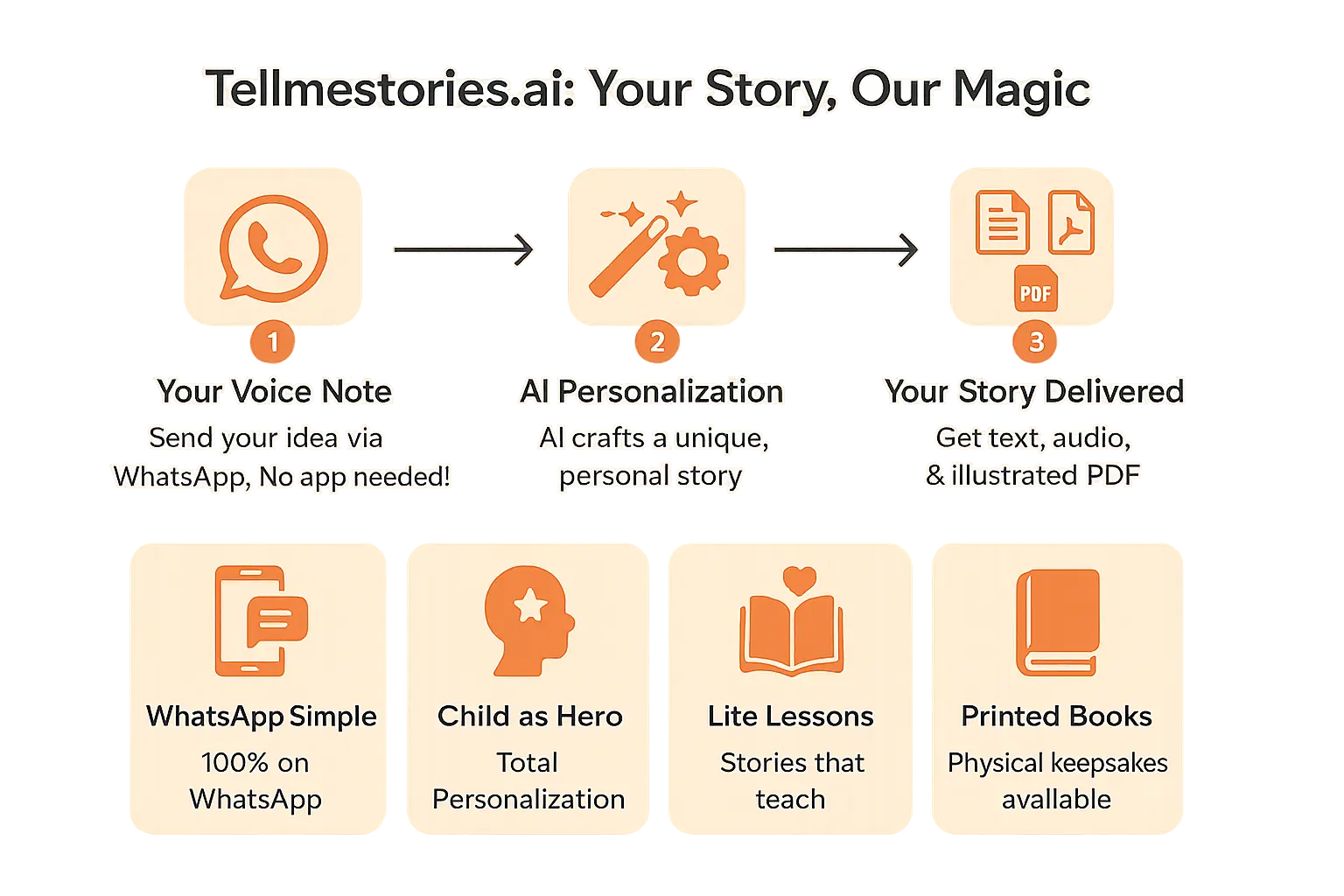
Step 1: Send a voice note on WhatsApp
No apps to download, no complicated forms. Just open WhatsApp and send a voice note on WhatsApp describing your child’s story. A 5-year-old astronaut? A coding princess? Say it out loud like chatting with a friend. Perfect for busy parents on the move! 📱
Step 2: Watch the AI magic
Our AI instantly transforms your idea into a truly personal story. It remembers your child’s name, age, favorite animals—even their obsession with purple tractors! The smart memory feature makes future stories even more tailored—like having a personal scriptwriter for your child 💡
Step 3: Get your story in any format
In 90 seconds, your tale arrives! Choose between illustrated text, audio story narrated by pros, or a downloadable PDF. Want a printed book? We’ll mail library-quality hardcovers with vibrant illustrations—perfect for showing off at daycare 📚
This amazing service for busy parents makes storytelling effortless. Want to try? Create your first story in 2 minutes!
- 100% on WhatsApp: Nothing to install!
- Total Personalization: Your child is the hero
- Educational stories: Life lessons made fun
- Physical keepsakes: Order stories as printed books
We created Tellmestories as parents, for parents. Our goal was to make it as easy as sending a message to a friend, but with a magical result
Why does this matter? Because 87% of parents say personalized stories make bedtime 10x cozier. Plus, the created by parents approach means we’ve built exactly what families need—from potty training parables to separation anxiety soothers. No tech jargon, no clunky apps. Just instant stories that feel like hugs for your child’s imagination 🤗
Even picky listeners get hooked; with Tellmestories.ai, “Wait—is that ME in the book?!” reactions ensure attention. For parents, just tap WhatsApp, speak your idea, and voilà—bedtime hero status in 90 seconds 🌙
Why understanding “how it works” matters
Ever felt overwhelmed by something you didn’t understand? That’s normal! Not knowing how things work makes life less scary. When you grasp the mechanics behind a process, you gain a sense of control. Think of it like solving a puzzle: once you see how the pieces connect, the bigger picture becomes clear.
Take personalized stories for kids. When parents explain how these tales are built (using the child’s name, photos, and interests), they turn abstract fear into something manageable. It’s like telling a child: “This monster under your bed? Let’s create a story where you defeat it together!” Suddenly, fear becomes a fun adventure.
Open-source projects like the Apache Software Foundation work the same way. Their success comes from shared understanding: everyone knows “how the engine runs.” This transparency empowers contributors to fix bugs, improve code, and innovate together. No mystery, just collaboration.
So what’s the takeaway? Understanding systems isn’t just technical—it’s emotional. It’s about turning uncertainty into curiosity. Whether it’s a bedtime story or a complex software, knowing “how it works” lets you engage, adapt, and grow. It’s the first step to learning, creating, and connecting. ✨
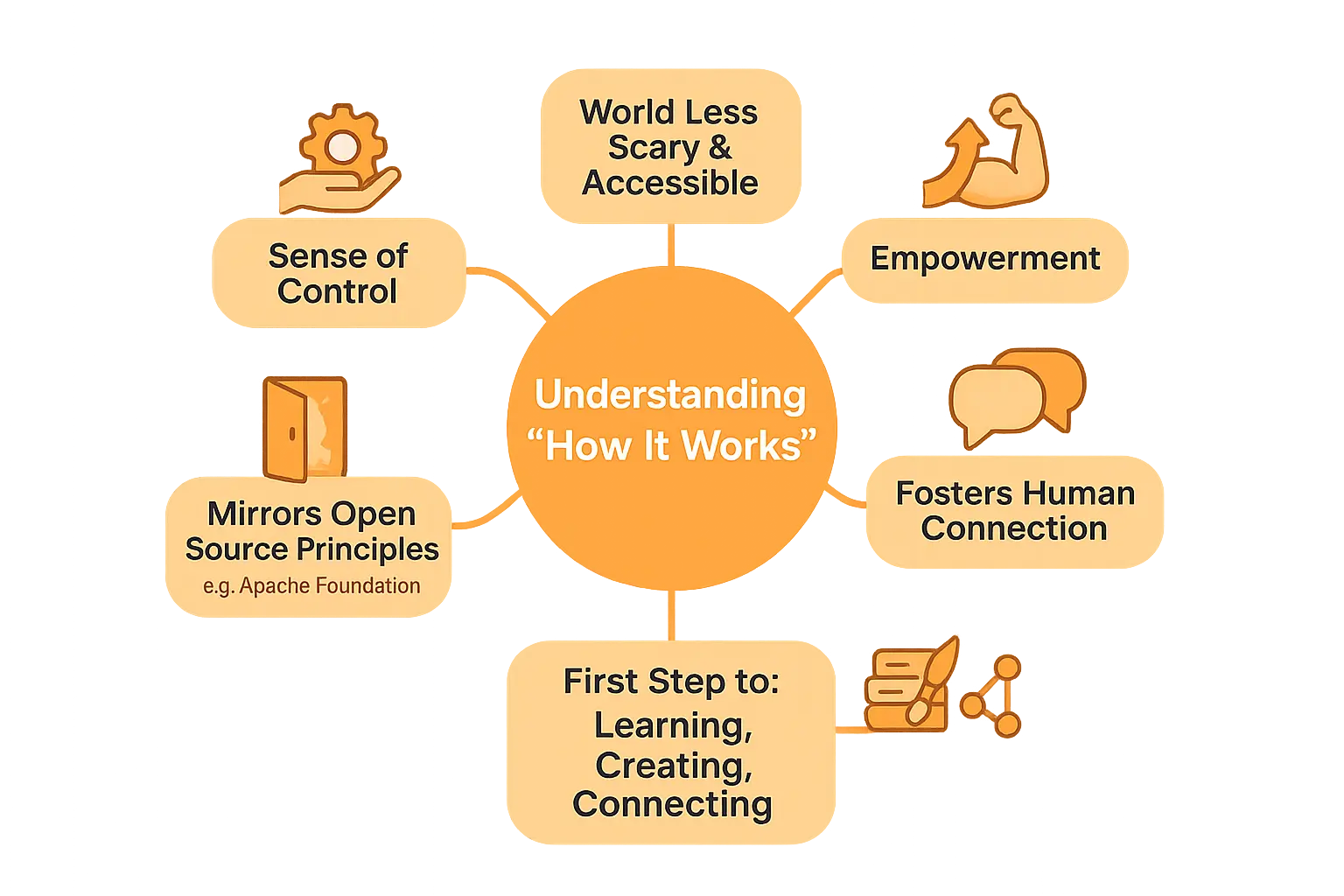
Understanding how things work gives power. 💡 Grasping mechanics builds control, making the world less scary. Sharing “how it works” sparks innovation (think Apache Foundation). From tech to recovery programs and AI storytelling, curiosity unlocks learning, creating, and connecting. Stay curious—the next big “how” might change your world. ✨
FAQ
How do you say “how it works”? 🤔
If you’re scratching your head wondering how else to phrase “how it works”, I’ve got you! You can say things like “how does it function?” or “what’s the process?”. For example, “HowStuffWorks” (a super cool site by the way) uses this idea to explain everything from car engines to space! It’s all about breaking down the big stuff into bite-sized pieces you can actually wrap your head around. 😎
How does it work in 12 steps? 🧩
Oh, this one’s a classic! When people ask about the 12-step version, they’re usually talking about programs like AA (Alcoholics Anonymous). The idea is to walk someone through a journey of self-discovery and growth. The 12 steps include admitting you can’t do it alone, finding a “Higher Power” (more on that later), making amends, and helping others. Think of it like a roadmap—each step builds on the last to get you from “I’m stuck” to “I’ve got this!” 🧭
What’s another way to say “how it works”? 🔄
Want to mix things up? Phrases like “how things operate” or “what’s the secret sauce?” work too! For example:
- “How does this whole thing tick?”
- “What’s the recipe for this?”
- “Explain the magic behind it!”
The goal? Make it sound less like a textbook and more like a chat over coffee! ☕
Why is step 7 such a big deal? 🤲
Step 7 in AA is all about humility, folks! It’s where you ask your “Higher Power” (could be nature, the universe, or even your support crew) to help you ditch your ego and flaws. Why the spotlight on step 7? Because it’s where you go from “I’ve got it all figured out” to “Hey, I need help!” It’s like finally admitting your phone’s battery is dead and asking for a charger—no shame, just results! 🔋
What’s the real meaning of “how it works”? 💡
Let’s break it down! “How it works” means taking something complicated and chopping it into manageable pieces. Imagine explaining how a pizza gets made: dough, sauce, cheese, oven—boom! You’re eating pizza. The magic? It turns “WTF?” moments into “Ohhh, I get it!” Whether it’s tech, nature, or even AA steps, the idea is the same: make the complex simple. 🍕
Is “how it works” grammatically correct? 📚
You bet it is! “How it works” is totally legit. It’s a question structure that’s been around the block. Think of it like asking, “How does this car engine tick?”—perfectly normal! Grammar-wise, it’s a question phrased as a statement. So go ahead and use it without sweating the small stuff. ✅
Why does AA feel so religious? 🙏
Okay, let’s tackle this head-on! AA gets called “religious” because of that whole “Higher Power” thing. But here’s the twist: it’s not about religion—it’s about spirituality your way. Your “Higher Power” could be your support squad, the stars, or even the idea of growth. The 12-step program is more about humility and letting go than dogma. Think of it like this: it’s not about a specific god, it’s about finding your “why” to keep going. 🌟
What’s CBT therapy anyway? 🧠
CBT (Cognitive Behavioral Therapy) is like a workout for your brain! The idea is to spot bad thought patterns and swap ’em for better ones. For example:
- Thought: “I’m gonna fail this test!”
- CBT: “I’m nervous, but I’ll study and do my best.”
It’s super practical, no fluff, and all about action. You’re not stuck in the past—you’re learning tools to feel better now. Pretty neat, right? 🛠️
What’s the 3rd step prayer? 🙏
Here’s the scoop! The 3rd step prayer from AA goes like this (deep breath):
“God, I offer myself to Thee—To build with me and to do with me as Thou wilt. Relieve me of the bondage of self, that I may better do Thy will.”
The vibe? Letting go of control and trusting the process. It’s not about religion—it’s about saying, “I’m ready to grow.” Think of it as asking for a co-pilot, not a backseat driver. 🛫