
The essential takeaway: On demand stories transform Agile by crafting user stories just-in-time, boosting flexibility and user focus. Aligning with Lean principles, teams pivot faster, cut wasted work by deferring decisions, and deliver current user needs. Example: A kids’ story app built via WhatsApp, leveraging its universal accessibility for instant delivery, avoiding app downloads and outdated interfaces.
Ever wasted weeks planning a project only to face shifting priorities at the starting line? 🤯 On demand stories are shaking up agile development by swapping rigid blueprints for user-centric, just-in-time magic. Imagine a chef prepping dishes before knowing the orders—sounds chaotic, right? That’s traditional backlogs. With on demand stories, teams cook up solutions as needed, slashing wasted effort, boosting flexibility, and zeroing in on what users actually need right now. Think WhatsApp-based story delivery or instant PDFs tailored to feedback—no more guessing games. Ready to flip the script on chaos? 🚀
(Word count: 96)
What are on demand stories and why they are revolutionizing agile development 🤩
Ever spent weeks crafting the perfect project plan, only to discover requirements changed before development even started? 💥 This frustration drives the rise of on demand stories in agile development. Unlike rigid workflows, these stories adapt to real-time needs, turning unpredictability into a competitive edge. Let’s break down how this shifts the game: no one gets everything right upfront. 📉
On demand stories aren’t bedtime tales—they’re dynamic user stories created just-in-time (JIT) during development. Born from Agile’s “respond to change” ethos, they let teams tackle priorities as they emerge. Take Tellmestories: stories generate when needed, using real-time inputs (age, name, interests). This user-centric approach cuts waste, boosts relevance, and keeps teams nimble. It’s like a GPS rerouting instantly—no more outdated plans. 🗺️
Why does this matter? Because on demand stories align with today’s fast-paced, user-driven world. They’re the antidote to outdated planning, turning vague ideas into actionable tasks when the time is right. For example, a sudden user feedback loop reveals a critical feature gap. Traditional methods stall, but Agile teams pivot instantly, creating on-demand stories to fix gaps. 🚀
In this article, we’ll explore how prioritization works in JIT frameworks, why small, negotiable stories beat rigid specs, and how to avoid over-planning. Spoiler: it’s about agility, not overcommitting. Ready to rethink your backlog? We’ll show how Tellmestories leverages these principles to create personalized tales in seconds, proving that flexibility and user focus beat static plans every time. Let’s dive in! 🚀
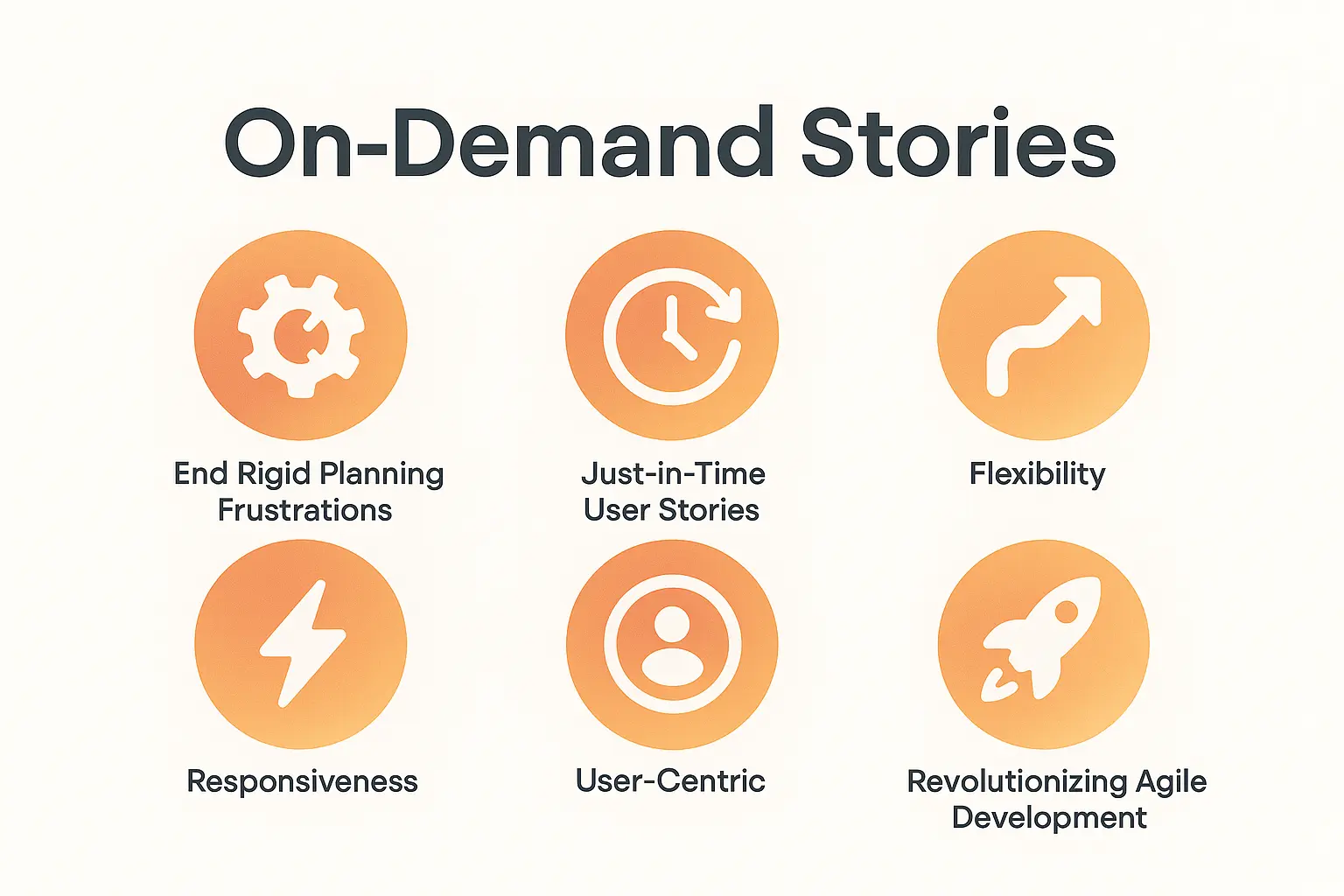
The core concept: moving from a backlog to a “just-in-time” flow
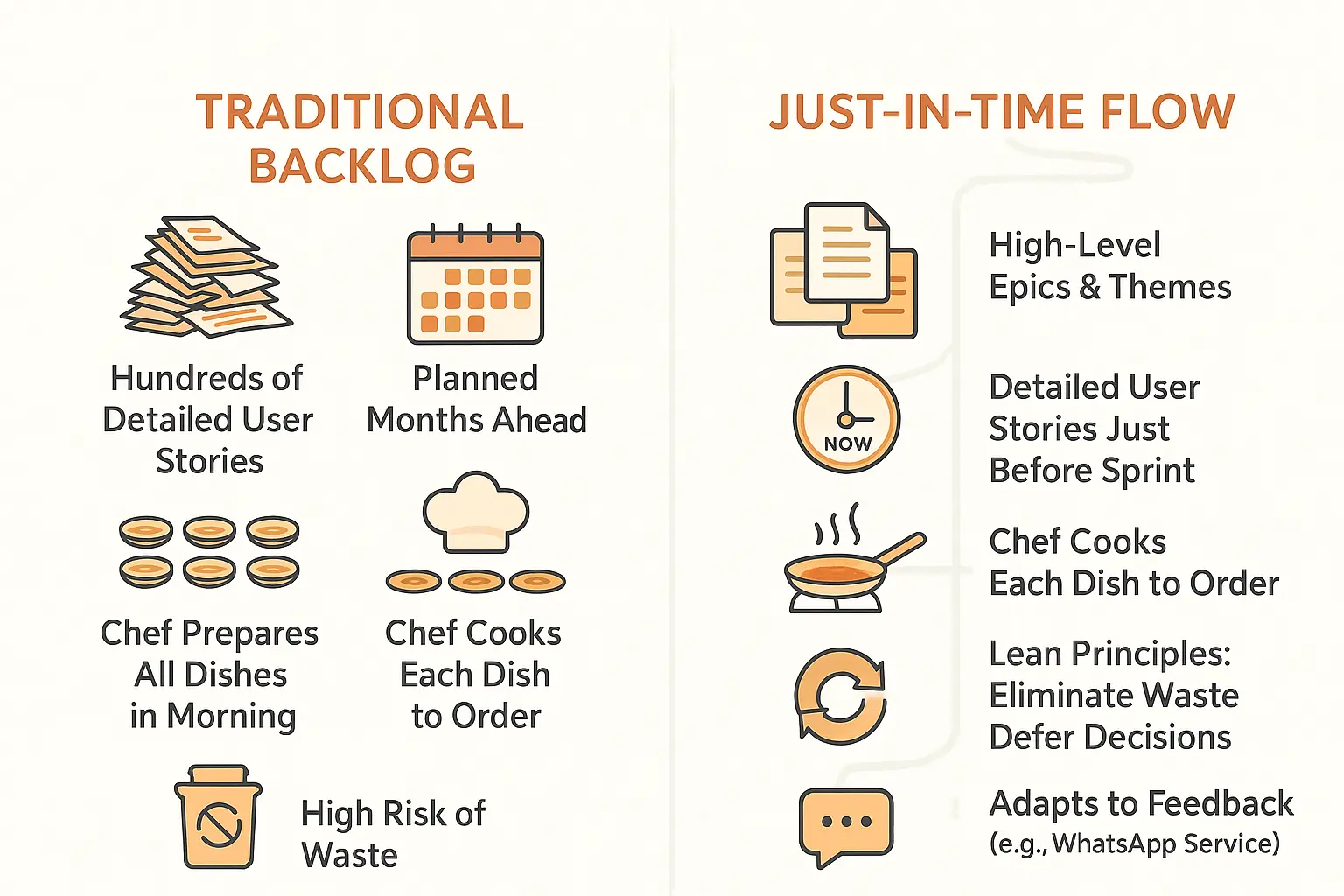
User stories in Agile aren’t about eliminating plans—they’re about smarter planning. Traditional product backlog methods often drown teams in hundreds of detailed stories upfront. On-demand stories flip this: high-level epics and themes live in the backlog, while granular stories get written just-in-time (JIT) before sprints. This reduces outdated requirements and keeps teams focused on what matters now. 💡
Think of a chef prepping meals for the week vs. one cooking à la carte. The first might waste ingredients on dishes no one orders. The latter adapts to real-time demand. Similarly, user stories created just before execution ensure relevance. No more guessing what users might need in 6 months—focus on solving today’s problems. 🍽️
Lean principles like eliminate waste and defer decisions drive this approach. Writing detailed stories too early creates “requirements bloat”—like overstocking inventory. JIT planning avoids this by delaying granular details until necessary. Teams save time, reduce rework, and stay aligned with user needs. It’s Lean principles in action: do less, but do it right. 🚀
Take a children’s story creation service. Instead of mapping every feature upfront, they start with a theme like “easy access.” Right before the sprint, they flesh out the story: “Parents send a voice note → AI crafts a tale → Stories delivered via WhatsApp.” This just-in-time flow lets them adapt to feedback—like adding audio narration or PDF options—without wasting effort. 📱
By linking JIT to real-world examples, teams avoid “build-it-and-they-will-come” traps. Stories aren’t static—they evolve with user input. This method aligns with Agile’s core: deliver value early, adapt often. And with tools like WhatsApp integration, even complex features become simple to test and refine. 🔄
JIT planning creates a natural feedback loop: build, test, learn, adapt. For the story service, this revealed parents valued voice interaction as a bonding tool during bedtime routines—insights impossible to capture in traditional backlogs. 🔍
Ultimately, JIT transforms Agile into a mindset. It’s not just about when stories get written, but how teams engage with user needs. The WhatsApp example shows rapid experimentation with immediate value focus. 🧠
The key benefits of building your product one story at a time
So, why should your team adopt this approach? 🚀 The benefits are huge. By focusing on one user story at a time, you create a development rhythm that aligns perfectly with Agile’s core principles. This method isn’t just about speed—it’s about delivering real, tangible value without drowning in endless planning.
Let’s talk user feedback. 🗣️ When you build stories just-in-time, you’re working with the freshest insights from your audience. Imagine skipping outdated assumptions and crafting features based on today’s pain points. This ensures every sprint addresses actual needs, not hypothetical ones. The result? A product that feels alive—constantly evolving with your users’ expectations.
What if I told you this approach could save you from wasted effort? 🌪️ By prioritizing stories that matter now, teams avoid building features that might get scrapped later. The ability to pivot quickly is a superpower. Market shifts? Competitor moves? No problem. Your roadmap stays flexible, turning potential roadblocks into smooth pivots.
Here’s where team focus kicks in. 🎯 When your squad works on what matters today, distractions fade. Think of it like this: instead of juggling ten half-baked ideas, you’re laser-focused on one story that drives real impact. This clarity boosts morale—everyone knows their work matters. And when teams feel that, efficiency skyrockets. 💡
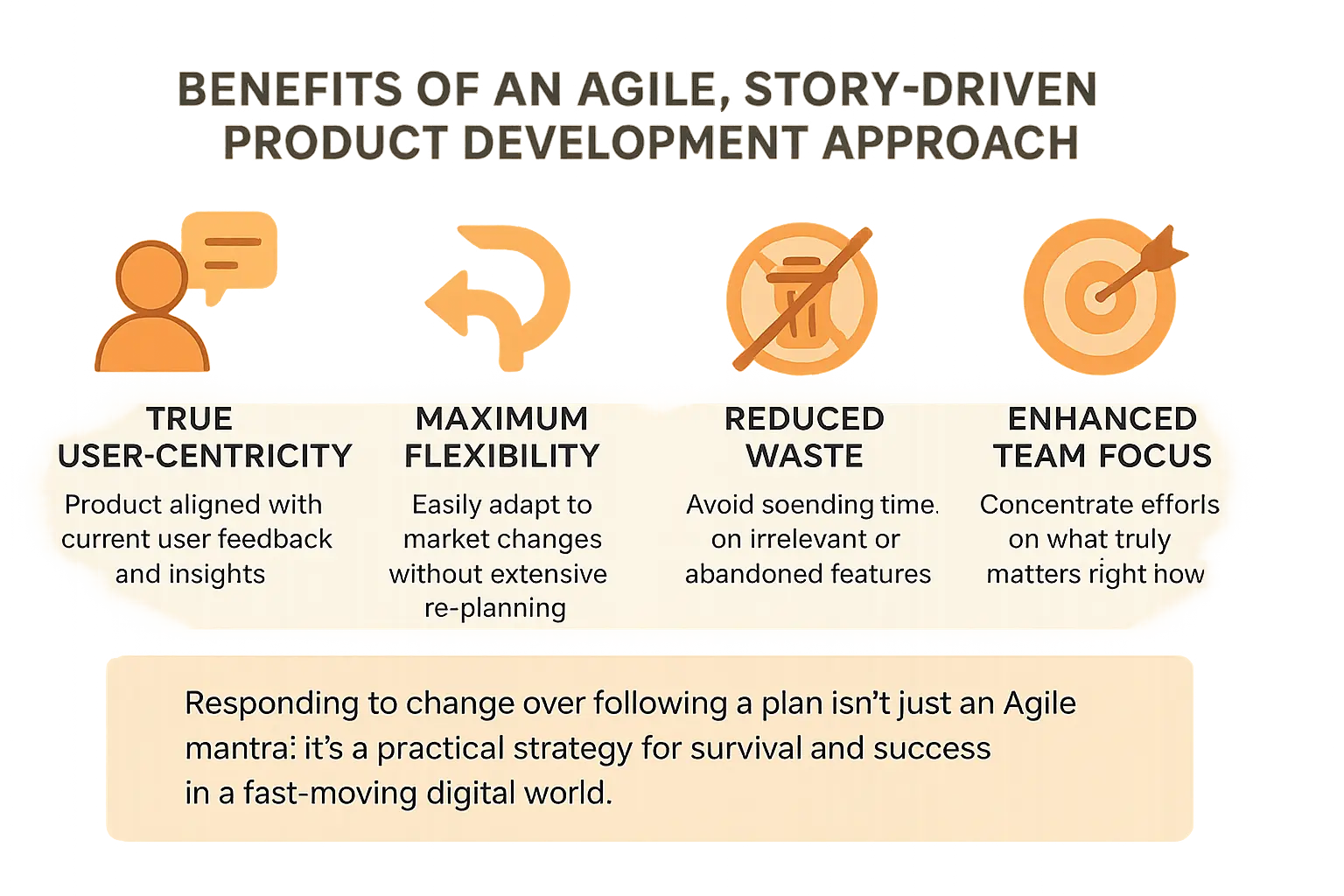
- True user-centricity: Stories are based on the most current user feedback and insights.
- Maximum flexibility: Easily adapt to market changes without throwing away months of planning.
- Reduced waste: Avoid spending time on features that are no longer relevant or valuable.
- Enhanced team focus: The development team works on what truly matters right now, boosting morale and efficiency.
Responding to change over following a plan isn’t just an Agile mantra; it’s a practical strategy for survival and success in a fast-moving digital world.
Ready to rethink your workflow? 🔄 Start small. Prioritize stories based on immediate user data, and watch how quickly your team delivers value. The future of product development isn’t about predicting it—it’s about building it, one story at a time. 📚
How to prioritize and manage on-demand stories without chaos
Does “on-demand stories” sound like organized chaos? 🤔 Not quite! Agile teams thrive by blending flexibility with strategic guardrails. The magic happens when teams prioritize based on real-time needs while keeping sight of the larger vision.
Big picture: Vision drives everything
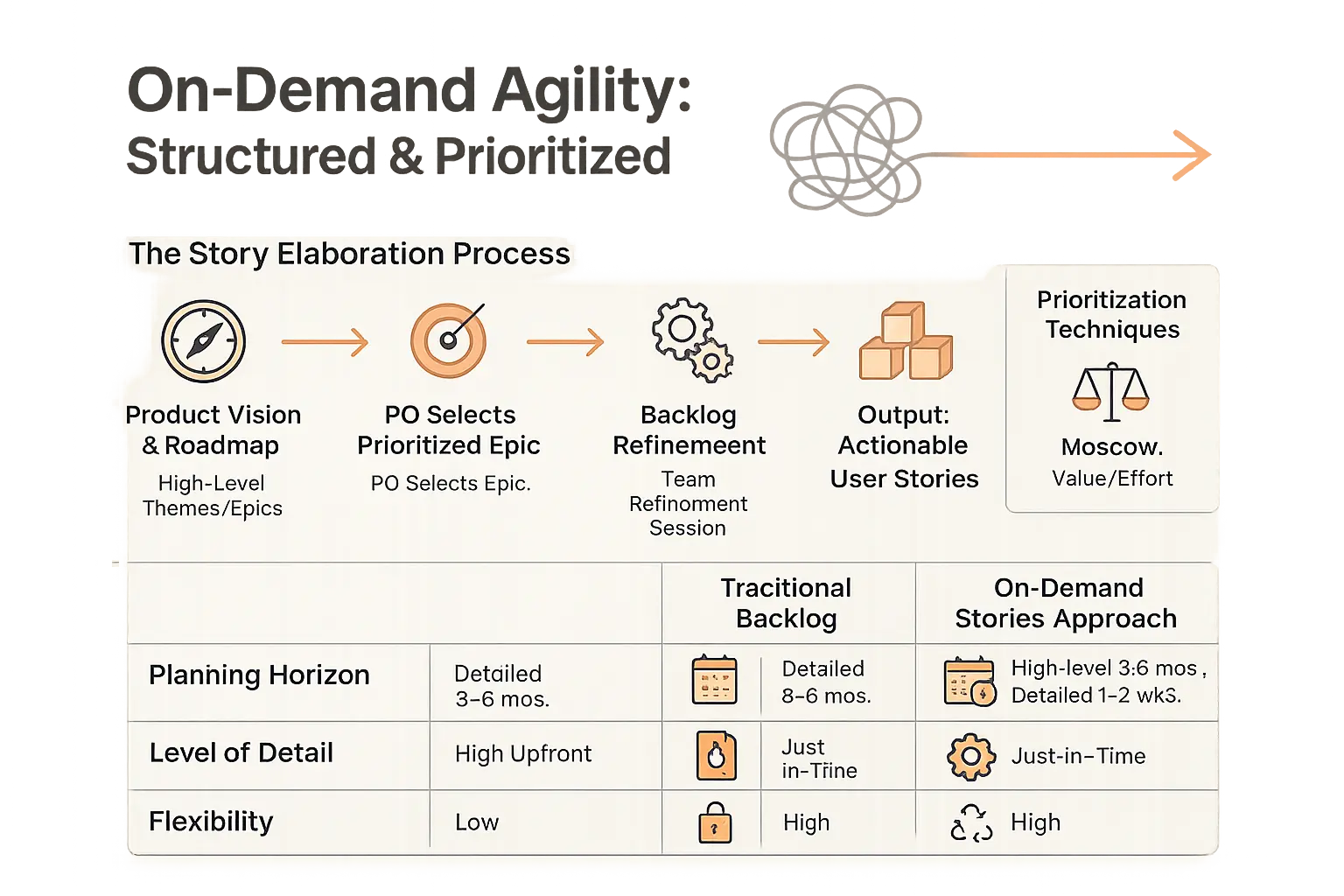
Think of your product vision as the North Star. For services like personalized children’s story creation via WhatsApp, this means anchoring decisions in themes like “Boost bedtime engagement” or “Simplify parent input.” These high-level goals guide prioritization without micromanaging execution. A roadmap isn’t a rigid checklist—it’s a living document that evolves with user feedback and market shifts.
From roadmap to action: The magic of story elaboration
Here’s where theory meets practice. Let’s say your roadmap highlights “Improve character customization” as a key initiative. When this epic reaches the sprint horizon, the team gathers for backlog refinement. Developers, designers, and the product owner dissect the epic into actionable user stories—like “As a parent, I want to upload family photos to create custom characters” or “As a child, I want story narrators to use my nickname.” This “just-in-time” approach prevents premature detailing that might become obsolete when real-world testing begins.
Smart prioritization made simple
Two frameworks keep teams focused:
- MoSCoW Method: Separate “Must-have” features (non-negotiable for product success) from “Should-have” and “Could-have” nice-to-haves
- Value vs. Effort Matrix: Visualize quick wins (high value, low effort) versus resource-heavy bets
For example, a children’s story app might classify “Instant story generation via voice notes” as Must-have, while “3D character avatars” land in Could-have. This clarity ensures teams tackle the most impactful work first.
| Aspect | Traditional Backlog | On Demand Stories Approach |
|---|---|---|
| Planning Horizon | Detailed stories for 3-6 months | High-level themes for 3-6 months, detailed stories for 1-2 weeks |
| Level of Detail | High upfront, stories fully written | Low upfront, stories detailed “just-in-time” |
| Flexibility | Low, changes are costly | High, pivots are easy and expected |
| Risk of Waste | High (rework, outdated stories) | Low (work is based on current reality) |
Why does this matter for user-centric products? Imagine building a story generator app where 60% of planned features never get used. Traditional methods often produce obsolete specs because they’re based on old assumptions. On-demand approaches keep teams focused on actionable user stories that solve today’s problems, not yesterday’s hypotheses.
Ready to transform your backlog?
Start incrementally: Pick one roadmap theme (e.g., “Smarter story recommendations”) and run a 45-minute elaboration session. Apply MoSCoW to separate “Must-have” stories from nice-to-haves. For instance, a voice-to-story feature might be Must-have for accessibility, while advanced filters become a Should-have. The goal isn’t to predict the future, but to create flexible actionable user stories that deliver value sprint after sprint. Your roadmap should breathe with user needs, not gather dust in a project management tool. 🌬️
Putting It Into Practice: A Step-by-Step Guide With Examples
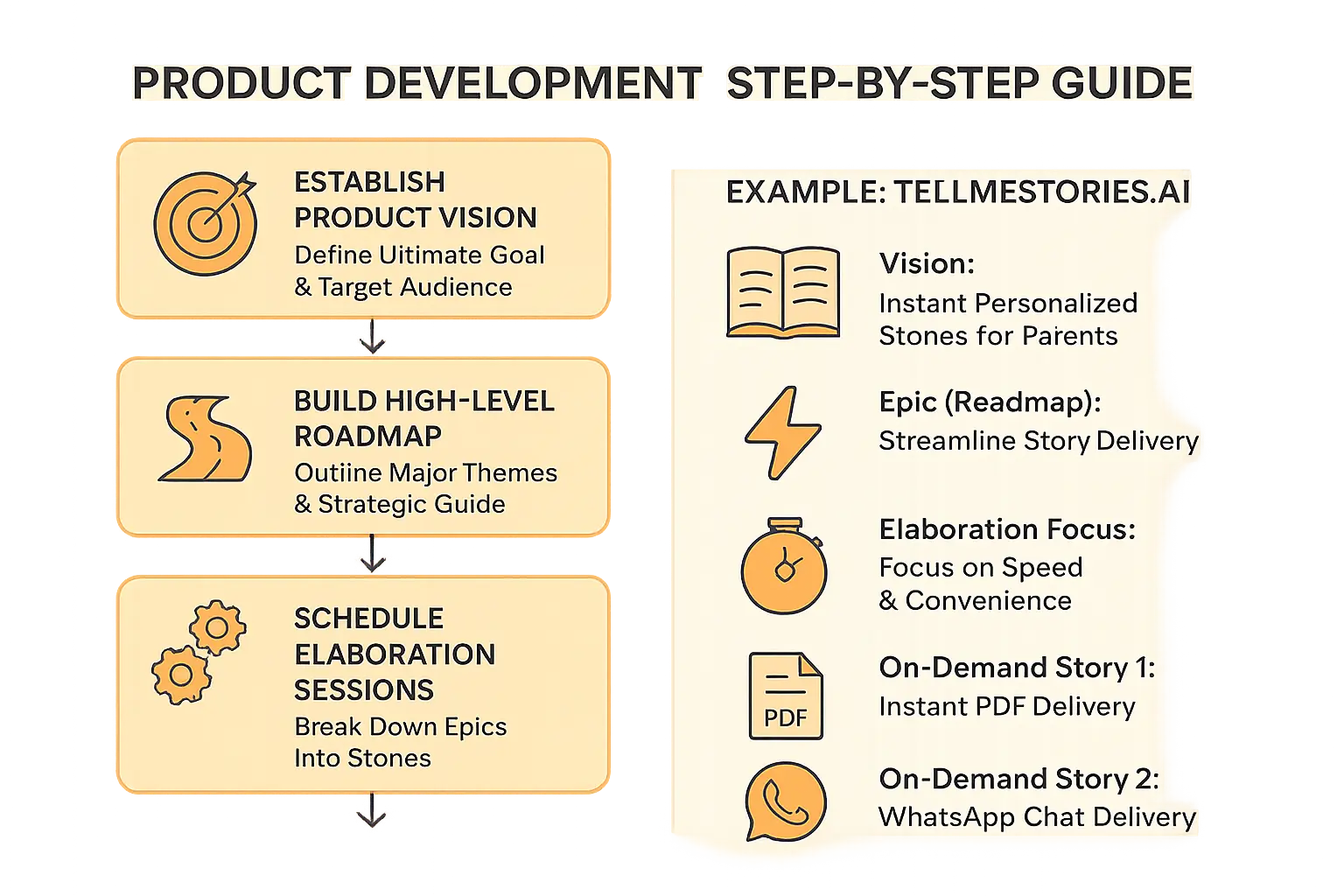
Ready to try it? Here’s a step-by-step approach to implementing on-demand stories in Agile frameworks. No guesswork—just actionable steps that align with user needs and team goals. Let’s dive in! 🚀
- Establish a Clear Product Vision: Define the problem you’re solving. For Tellmestories.ai, it’s about helping parents create personalized educational stories for kids instantly via WhatsApp. Without clarity here, teams risk building features nobody wants.
- Build a High-Level Roadmap: Map out major themes or epics. Tellmestories’ roadmap might include “Streamline Story Delivery” or “Expand Memory Feature” to enhance personalization.
- Schedule Regular Elaboration Sessions: Dedicate time weekly to break down epics into user stories. For example, refining “Streamline Story Delivery” into actionable tasks like PDF downloads or WhatsApp integration.
- Define “Ready”: Set criteria for “ready” stories. Does the story include acceptance criteria? Is it small enough for a sprint? This avoids scope creep and delays.
Let’s ground this in reality. Imagine Tellmestories’ team working on their “Streamline Story Delivery” epic. During an elaboration session, they identify two critical on-demand stories:
- “As a busy parent, I want instant PDF delivery of my story so I can read it to my child right away.”
- “As a user, I want stories delivered directly in WhatsApp—no app downloads needed.”
These stories reflect real user pain points: speed and convenience. By prioritizing them, Tellmestories stays user-centric while leveraging Agile’s flexibility. The “memory feature” (remembering a child’s preferences) emerged from similar sessions, turning feedback into a core differentiator.
Now, zoom out. On-demand stories aren’t limited to software. Euronews’ VOD service follows the same logic: users get news videos on-demand, precisely when needed. This user-first approach—whether for kids’ stories or global news—drives engagement by meeting audiences where they are.
Key takeaway? Start with a product vision that resonates, map your high-level roadmap, and refine stories iteratively. Tools like WhatsApp’s seamless integration (no app downloads!) or Euronews’ VOD prove that user-centricity wins. Ready to build your own on-demand strategy? 🧠
Overcoming common challenges on the path to agility
Switching to an on-demand model requires a mindset shift, and it comes with its own set of challenges. Teams often struggle with uncertainty, communication gaps, and siloed decision-making. Addressing these issues isn’t just about tools—it’s about culture, collaboration, and clarity. Teams transitioning from waterfall might fear losing control; consistent reinforcement of Agile values through workshops and small wins helps overcome this.
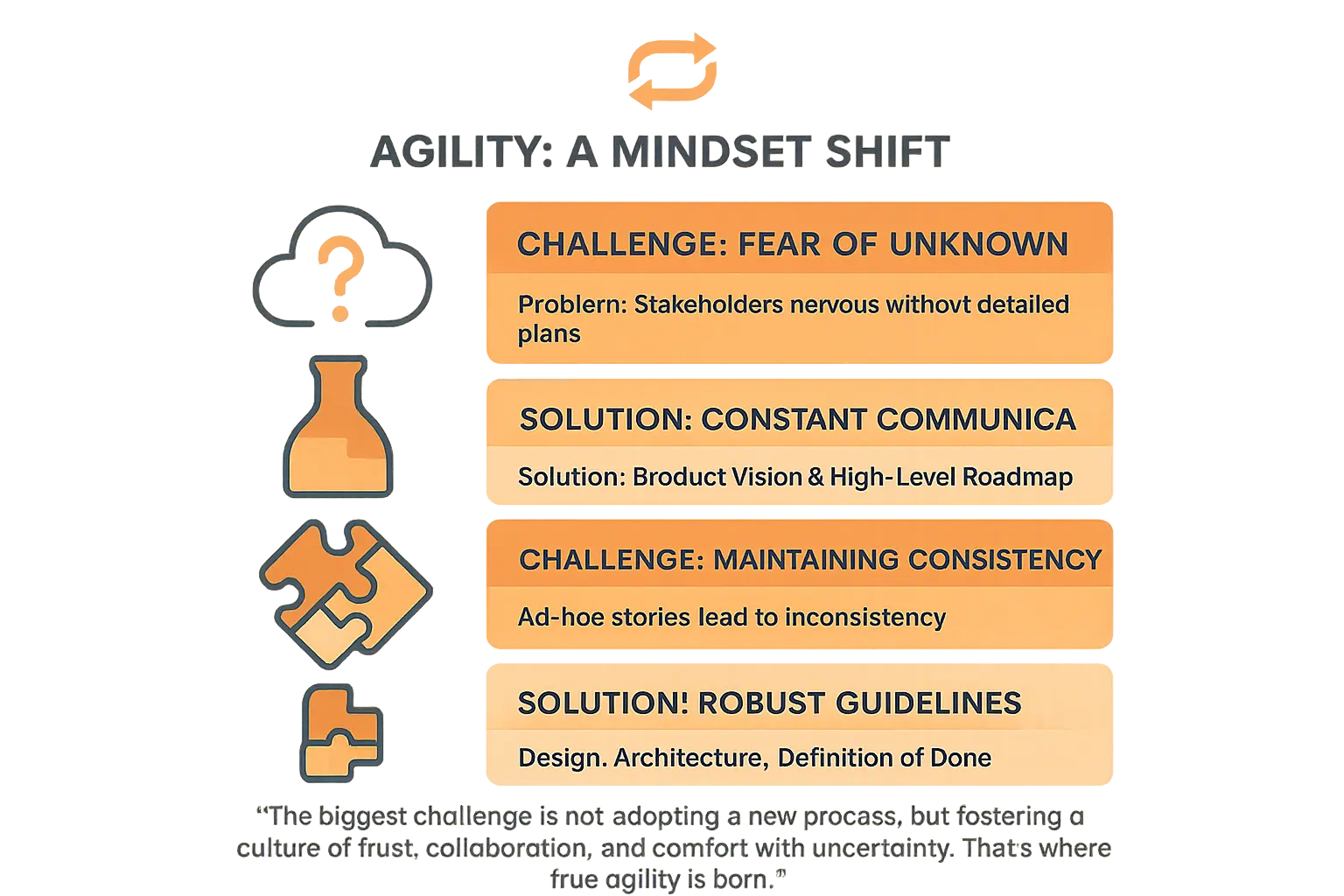
Challenge 1: The fear of the unknown
Stakeholders and team members might worry about lack of structure without rigid plans. The fix? Prioritize communication around your product vision and high-level goals. Share your “north star” regularly. For example, a retail software team reduced anxiety by aligning sprints with quarterly objectives during monthly “vision check-ins.” This transparency built stakeholder trust, even with evolving requirements.
Challenge 2: The product owner bottleneck
Product Owners (POs) can become overwhelmed as sole gatekeepers for user stories. The solution? Shift to collective ownership. Let developers, designers, and QA engineers co-create stories. The PO becomes a facilitator, not a dictator. Teams at tech startups often adopt “story kickoffs” where engineers clarify requirements directly with customers, reducing PO dependency. Decentralizing ownership helps teams like Spotify’s squads maintain agility at scale.
Challenge 3: Keeping consistency in chaos
On-demand stories might lead to fragmented features without alignment. How to maintain coherence? Use strong design guidelines, a robust technical architecture, and a strict Definition of Done (DoD). Require code reviews, accessibility checks, and UX validation before marking a story as complete. Companies like Netflix enforce “code health” in their DoD, ensuring seamless integration. Their “chaos engineering” also tests resilience proactively, preventing technical debt from derailing future iterations.
The biggest challenge is not adopting a new process, but fostering a culture of trust, collaboration, and comfort with uncertainty. That’s where true agility is born.
Agility thrives when teams embrace iteration as a strength. By addressing bottlenecks early and reinforcing shared accountability, organizations turn obstacles into opportunities. Remember: Agile evolves with your team’s maturity and market demands.
Time to start: are you ready for on demand stories?
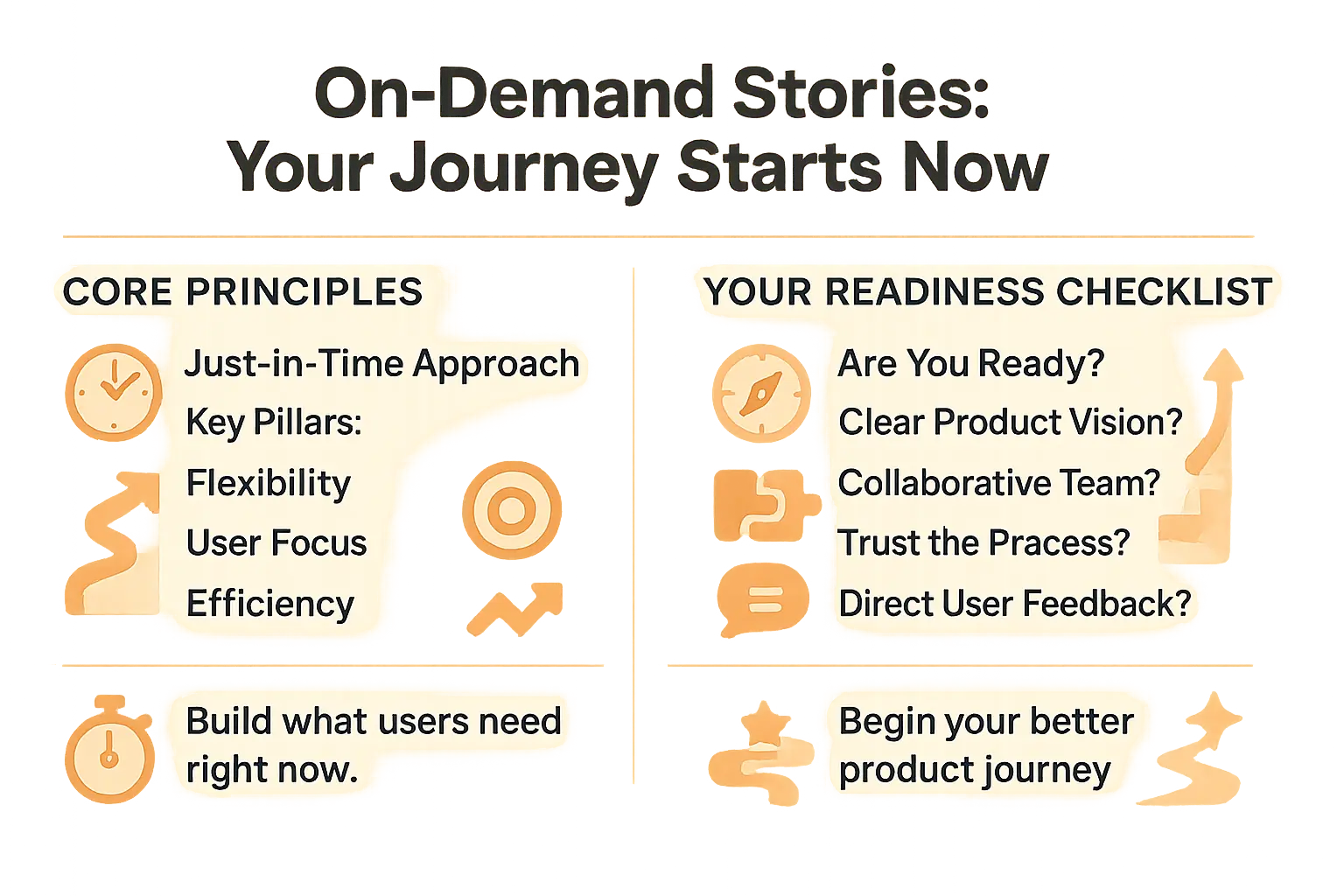
Flexibility, user focus, and efficiency define on-demand stories in Agile. These stories prioritize user needs in real-time, letting teams adapt to evolving requirements. By focusing on immediate value over rigid plans, teams reduce waste, accelerate delivery, and stay aligned with user expectations. It’s not about skipping planning—it’s about timing. Just-in-time requirements keep everyone nimble, turning uncertainty into opportunity. 💡
- Do you have a clear product vision? Start by defining your “why” before diving into details.
- Is your team collaborative? On-demand stories thrive on open communication and shared ownership.
- Are you willing to trust the process? Let go of micromanaging—embrace iterative progress.
- Do you have a direct line to user feedback? This is your compass. Without it, you’re navigating blindfolded. 🧭
Stop building for a future that might not happen. Start solving right now for users who need you today. Agile isn’t about perfection—it’s about responsiveness. Your first on-demand story could be the spark for faster, smarter development. Ready to rewrite the rules? 🚀
What will yours be? 😉 Whether it’s a new app feature or a bedtime tale for a child, the principle is the same: start with a clear need and create it instantly.
On-demand stories redefine Agile with flexibility, user focus, and efficiency. Ditch rigid backlogs—prioritize just-in-time planning to cut waste and adapt swiftly. Challenges? Solvable with open communication. Ready? Start with vision, teamwork, and real-time user needs. The future isn’t planned—it’s built now, one story at a time. 🚀 Need inspiration? Try instant creation at [Tellmestories.ai](https://tellmestories.ai/create/instant/).
FAQ
Are people still making money with print-on-demand?
Yes, absolutely! 💸 Many creators and entrepreneurs still thrive with print-on-demand (POD). Take Gay Pride Apparel or Jolie Noire—they’ve built successful brands by focusing on niche markets, leveraging social media, and prioritizing community engagement. The key? Low upfront costs, creative flexibility, and staying adaptable to trends. You’re not printing inventory; you’re creating when someone actually wants your product. It’s not a “get-rich-quick” scheme, but with persistence, it’s totally viable. 🚀
What is “on demand” and how does it work?
“On demand” means creating products or services exactly when a customer orders them. Think no inventory, no guessing games—just make it when someone says “yes, I want this!” 🛒 For example, a T-shirt designed today might be printed tomorrow once sold. Platforms like Printful or Amazon Merch handle the logistics, so you focus on creativity. It’s ideal for artists, writers, or anyone with a story to share but no storage space for boxes of merch. Just design, upload, and let the platform handle the rest. Easy, right?
What’s the success rate of print-on-demand?
Here’s the deal: There’s no one-size-fits-all success rate. 📈 But here’s the good news: Your odds skyrocket if you nail three things. First, target a niche (like DUMBCLUB did with TikTok challenges). Second, build a community (see: Rebel Youth’s authentic storytelling). Third, stay consistent. Stats vary, but creators who blend strategy with passion? They’re the ones hitting 6-7 figures. No magic formula—just sweat, data, and a sprinkle of luck. ✨
What’s an example of an on-demand economy?
The on-demand economy is everywhere! 🌍 Think Uber (ride-hailing), Netflix (streaming), or even Tellmestories.ai—where parents get instant, personalized kids’ stories. But here’s the twist: It’s not just services. Print-on-demand brands like Starrypaige (art on demand) or UMAI Clothing (anime-inspired streetwear) prove products can be “made-to-order” too. The magic? Flexibility and zero inventory stress. You create value when someone’s ready to buy it. Brilliant, huh?
Can I start print-on-demand with no money?
Technically? Yes. Realistically? You’ll need some budget for design tools or marketing. But here’s the hack: Use free resources like Canva for designs, leverage social media (free reach with consistency!), and start small. Brands like Own Your Stigma began by sharing messages they believed in—no huge investment, just passion. Focus on creativity over capital 💡. Platforms like Etsy or Shopify let you set up shop with minimal fees. Pro tip: Start with one product, then scale. Rome wasn’t built in a day, right?
What’s the average salary for print-on-demand?
Short answer? It varies. 📊 Some make $50/month; others, like UMAI Clothing, hit $100k/month. Your income depends on your hustle, niche, and audience. High-ticket items (e.g., custom books) or licensing deals (like Project SIRIN’s Ukraine support merch) can boost earnings. Platforms often pay royalties per sale, so volume matters. But here’s the truth: Treat it like a side hustle, and it’ll stay one. Treat it like a real business? The sky’s the limit. 🚀
How do you get paid on demand?
Simple: When someone buys your product or service, the platform (like Amazon KDP or Teespring) takes a cut, and you get the rest. 💰 For print-on-demand, payments often hit your account 15–30 days post-sale. Platforms like Patreon or Substack let fans support you directly—think “buy me a coffee” models. For services (e.g., personalized stories), set rates via your website and use PayPal/Stripe. Pro tip: Automate payouts and track expenses. Tools like Shopify or Etsy handle the math so you can keep creating. Time to get paid? Time to get set up. 😉
What’s an example of a VOD platform?
Video-on-demand (VOD) is everywhere! 📺 Think Netflix, Disney+, or even Euronews’s on-demand news clips. But here’s a twist: Niche platforms like Tellmestories.ai use VOD principles for personalized kids’ stories. Parents “stream” custom tales instantly, no physical books needed. The rule? Convenience is king. Whether it’s binge-watching a series or buying a T-shirt at midnight, on-demand wins when you want it, when you want it. 🕒