Your child knows the story by heart, and still the yawns come early.
Some children lean in, while others drift off mid-page. Here is what research says about why personalized bedtime stories work, and where their calming power stops.
Why personalized stories can hold a child’s attention

Picture it: your child hears their own name in the first sentence, and suddenly the page feels like it was written for them.
That small shift changes everything. Their name, their look, a favourite toy, a family member, or a familiar place makes the story feel close. That can make it feel relevant right away.
That closeness helps guide attention. Your child may look more carefully, listen for the details that belong to them, and wait eagerly to see what happens to a character who feels like a friend.
Personalized details may help your child stay engaged during shared reading.
Your child may also slip into the hero’s shoes. Psychologists call this identification: seeing parts of yourself in a character. The link can come from a name, a look, an experience, a fear, or a beloved activity.
Age and familiarity still matter. A three-year-old may light up at their own name and teddy bear. A six-year-old may care more about a problem, an adventure, or a hero who feels like them. The best details are the ones your child already knows and enjoys.
Shared reading offers the strongest established benefits
Personalization may help your child connect the story to their own life. The wider benefits come from sharing the book with you, talking together, and returning to language in a warm, close setting.
Shared reading builds two kinds of language skill. Expressive language is the ability to use words and sentences. Receptive language is the ability to understand them. Reviews of parent-led book-sharing programmes have found positive effects in early childhood, though the average effect is modest.
Try asking, “What do you think will happen next?” or “Why does the character feel worried?” You can also pause and follow your child’s own question, rather than steering them straight back to the printed words.
A personalized book can make those connections easier to start. Your child might say, “I have that teddy,” or “I went there too.” You can build on it: “Yes, your teddy sleeps beside you, just as the bear sleeps beside the little fox.”
Bedtime can soothe through routine, not personalization alone
A bedtime routine gives the evening a shape you can count on. With fewer decisions and familiar signals, your child knows sleep is coming.
Personalization may make your child want to listen. But it has not been shown to help children fall asleep. Research has looked at engagement, speech, vocabulary, and comprehension, not whether personalized stories help children fall asleep.
The setting around the story matters more. A thrilling plot, a loud voice, or a story about danger can leave a sensitive child wide awake. To wind down, pick gentle conflicts, reassuring endings, and familiar feelings.
Stories that calm versus stories that wake
Calming stories
- Gentle conflicts
- Reassuring endings
- Familiar emotional situations
Stories that may keep a child awake
- A thrilling plot
- A loud reading voice
- A story about danger
Keep screens out of the bedroom. The American Academy of Pediatrics advises turning them off at least one hour before bed. A printed book, or a parent reading aloud, skips the light and the pull of a device.

Adapt the reading to your child’s signals
One child may enjoy three quiet pages. Another may ask for a whole chapter. The better guide is your child’s attention, mood, and the time left before sleep.
As children grow, offer longer stories and richer vocabulary. Early readers can take on a sentence or a page. You can read material a little beyond their level.
Watch for signs that it’s time to stop:
Three signs it’s time to stop
-
Restless body
Your child turns away, climbs out of bed, or keeps shifting position. Close the book gently rather than pushing through the final pages.
-
Tired voice
Repeated mistakes, irritability, or sudden tears may show that sleep matters more than finishing the story.
-
Emotional tension
A worried face, a tense body, or a repeated question about danger calls for a pause and reassurance.
Pauses are part of reading. Let your child point, comment, wonder, and return to a favourite page.
Personalization has potential, with clear limits
Personalization may help your child stay engaged and make personal connections. Shared reading may also encourage conversation and help your child retell what happened in the story.
| Reading experience | What may support engagement | What you can do together |
|---|---|---|
| Personalized story | The name, appearance, pet, toy, or place feels close to the child | Ask what your child recognises and what feels different |
| Generic story | New characters and situations invite imagination and perspective-taking | Ask how your child feels about the character’s choices |
| Personalized and generic pages | Comparing familiar and unfamiliar details sparks conversation | Ask, “What is like you, and what is new?” |
| Shared reading of either type | Your questions, pauses, and explanations build language practice | Let your child answer, predict, retell, or change the ending |
The research has limits, though.
Most studies look at small groups of preschool or kindergarten children. The reading sessions are short, and the books are carefully designed.
One reading session does not prove that personalization leads to lasting gains in language, imagination, sleep, or emotional growth.
The effect may also wear off if every story follows the same pattern.
Personalized stories can be one part of a varied reading life. Your child still needs books that show them lives unlike their own.
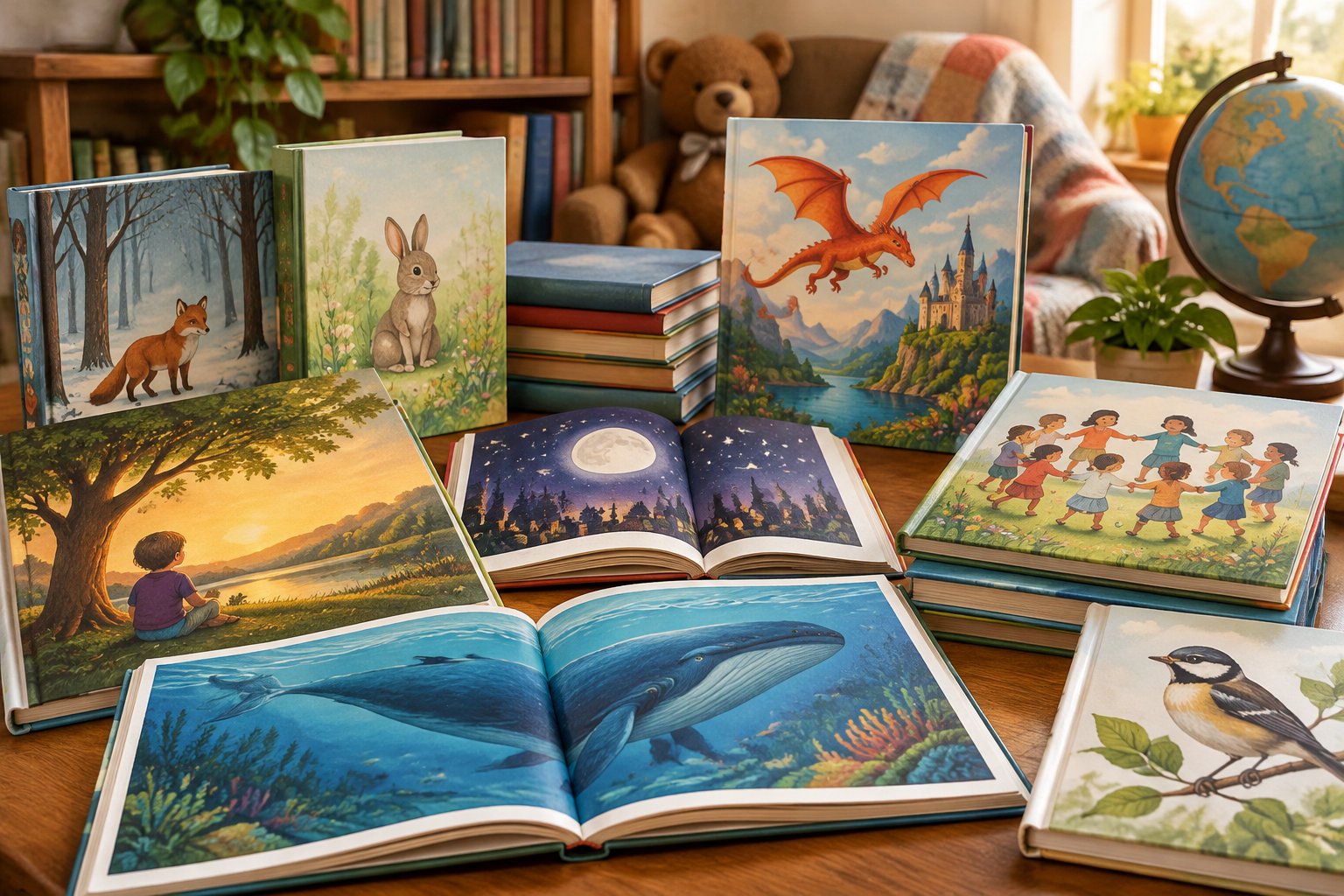
A personalized story can be one part of a varied reading life, alongside:
- folk tales
- picture books
- poetry
- humour
- information books
- stories with unfamiliar heroes
A simple bedtime ritual can work at home
Start with a sequence you can repeat most evenings. A short, calm pattern is easier to keep. An ambitious routine often leaves everyone rushed.
Six steps keep the evening predictable:
- Begin the wind-down: lower the lights and finish energetic play before the story.
- Complete practical tasks: wash, brush teeth, use the toilet, and put on pyjamas before opening the book. This keeps the final minutes quiet.
- Choose the right story: match the length, language, emotional tone, and subject to your child’s age and mood. Familiar stories are a comfort on difficult evenings.
- Personalize the conversation: notice the detail your child cares about, then ask one open question.
- Follow your child’s pace: pause for comments, skip a page when attention drops, or stop when tiredness takes over.
- End the same way: close the book, offer a cuddle or a brief goodnight phrase, and keep the final step predictable.
If the story excites your child, shorten it. You can also choose a quieter book or move reading earlier in the routine. If it worries them, name the feeling. Tell them they are safe. Then switch to a familiar story with a reassuring ending.
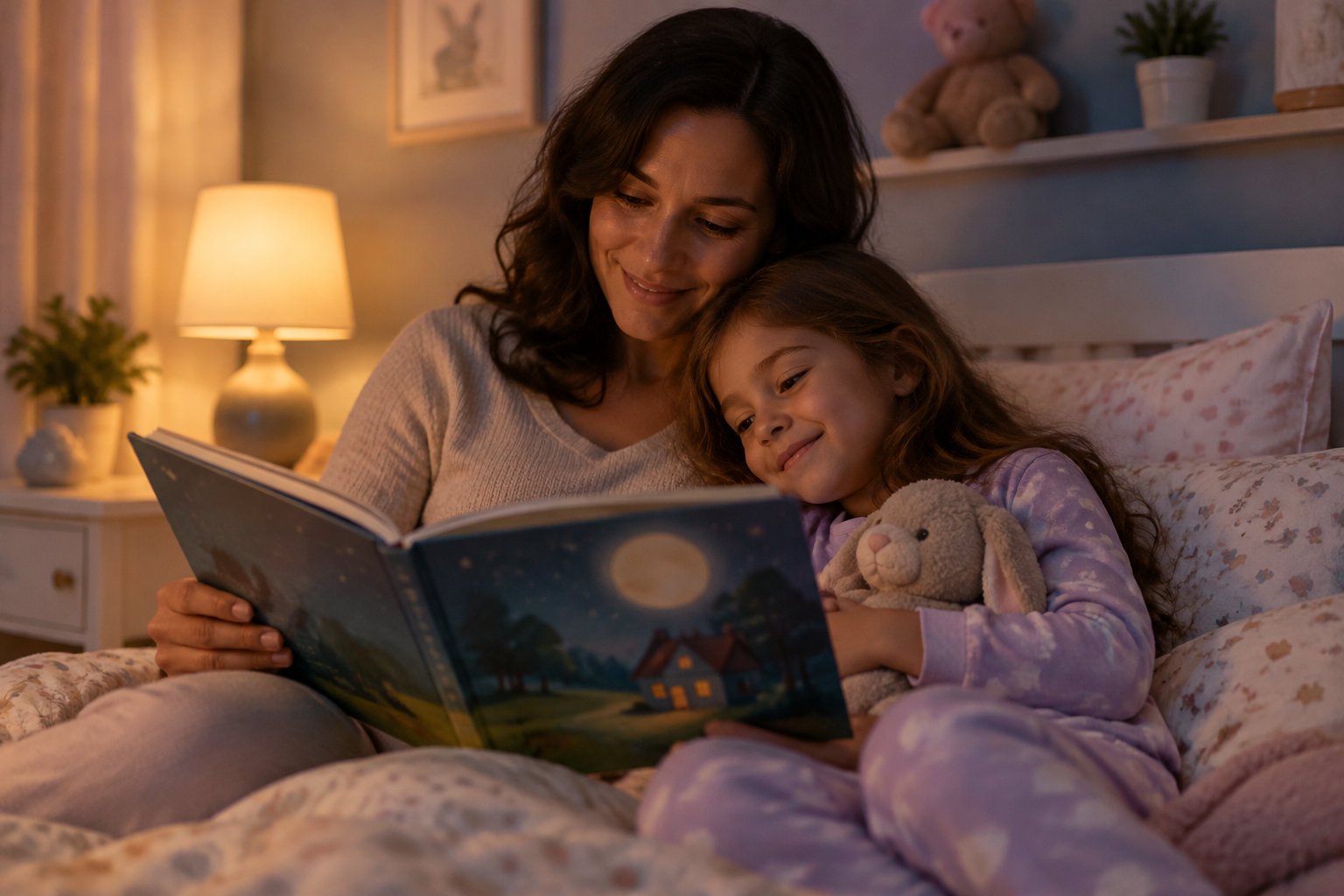
A personalized bedtime story won’t improve sleep every night or teach a new word on every page. Its realistic value is that it may make your child eager to join you, while the shared conversation and a dependable ritual do the deeper, everyday work.
Your child will not remember every page, and that is fine. What matters is the evening you build together, night after night. Keep the voice low, let the questions wander, and notice which moments your child carries into the next day. Those small, repeated moments are the ones that tend to stay.
FAQ
From what age can you read bedtime stories to your child?
You can read aloud from birth. Your baby may not follow a plot yet, but can hear your voice and the rhythm of the words.
Start with songs and short picture books, then move to longer stories and chapters as your child grows.
Who can share bedtime stories with your child?
You can share bedtime stories with your child, and invite another trusted adult, such as a grandparent or older sibling, to read too.
What counts most is the warm, responsive exchange between you and your child, whoever is reading.
At what age should you stop reading bedtime stories?
There is no fixed age to stop. Keep reading with your child for as long as they enjoy listening.
As they grow, take turns reading, read chapters, or choose stories that match their new interests.
Do children need to understand the story for reading to help?
No. Babies and young toddlers can benefit from hearing your voice, rhythm, and repetition before they follow a full story.
Their part in the reading will change as their attention and language develop.
Can a child have too much personalization?
Yes, if the details make the plot confusing, overstimulating, or less enjoyable.
Use a few meaningful details, then leave room for unfamiliar characters, settings, and ideas.